We’re excited to work with Frogtek, which brings business tools to micro-retailers through mobile phones. Frogtek’s first product allows micro-retailers to record store revenues and expenses on smart phones. Its founder, David del Ser, is one of this year’s Echoing Green fellows.
We’re working with David and Frogtek to create a basic business curriculum that micro-retailers can teach themselves on their phones when they have downtime at their shops. We welcome suggestions, especially from those familiar with e-learning.
E.B. MAGALONA – Thursday’s ‘wow’ was premature. Friday’s field teaching in a small fishing village here demonstrated how far we’ve come in ways we couldn’t have dreamed of even a week ago.
Participants spent Thursday evening and Friday morning preparing the lessons they’d teach to villagers. Some drew pictures. Some wrote out simple math. Some tweaked content, replacing drought with typhoon to make a lesson relevant in a place that would not exist without fish farming.
E.B. Magalona, a fishing village in Negros
And then we were off. We drove north of Silay through unpaved roads amid fields of sugar cane, arriving in this fishing village just in time for the loan officer’s weekly meeting. We gathered in a small hut as NWTF officers checked the progress of borrowers’ repayment, introduced our group, and eventually gave control to our participants.
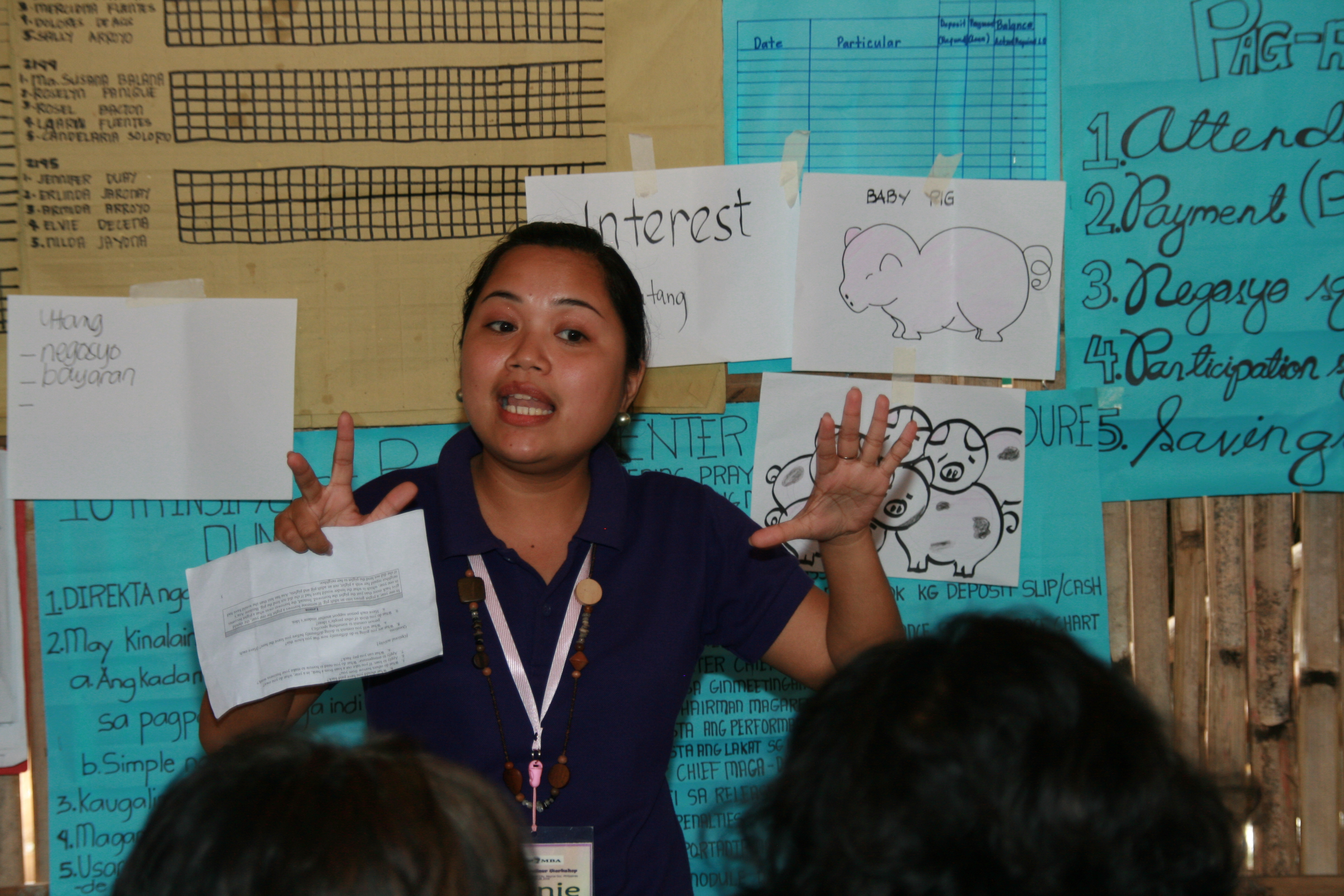
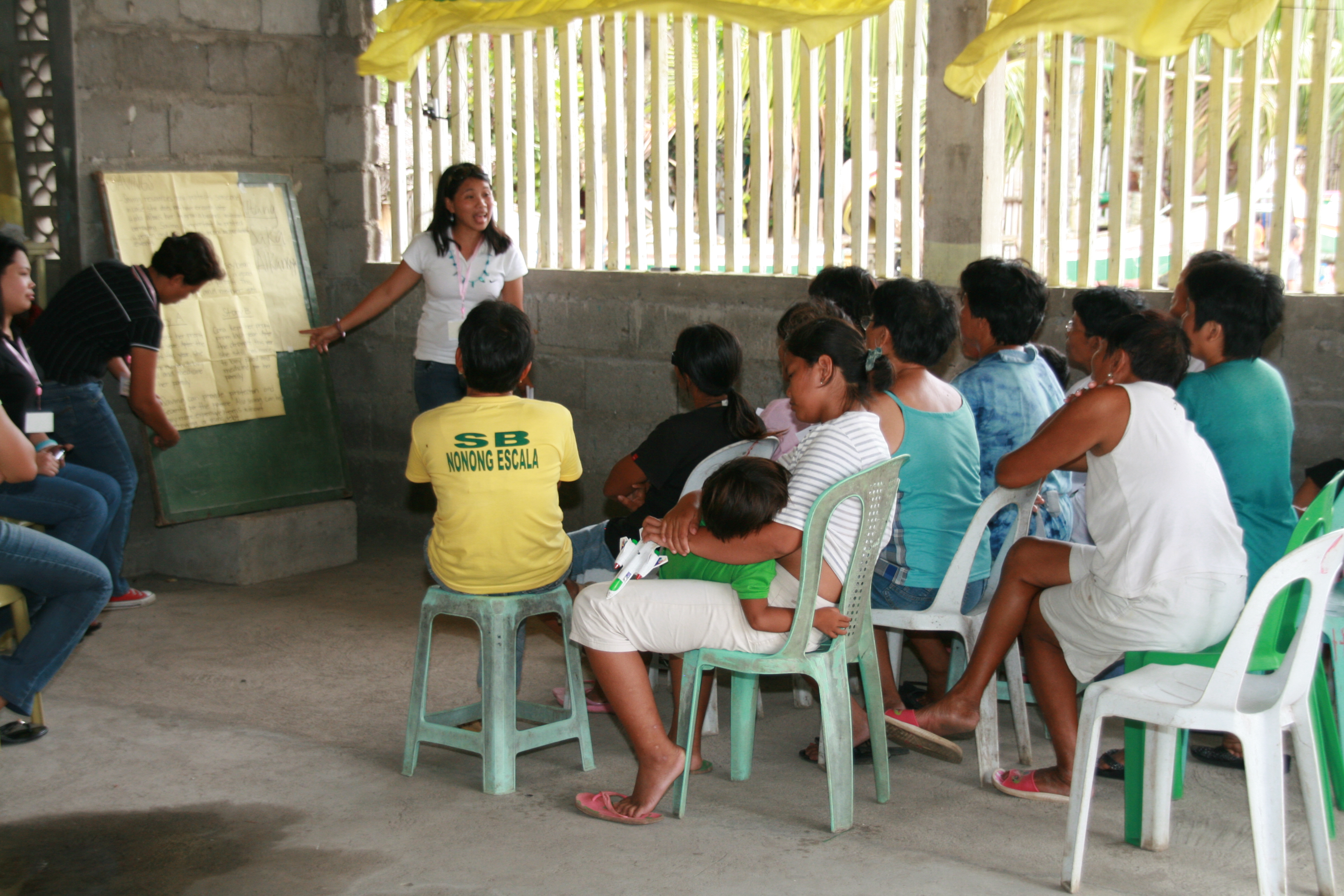
We split into 4 groups of 10 to 15 villagers each. In those groups, something magical happened. In the native dialect, our participants patiently explained why they came. Villagers sat with rapt attention as they learned about debt, interest and saving. These were not necessarily new concepts, but presenting them in new light made them easier to grasp – and motivated the villagers to run better businesses, they said. Villagers understood the stories. The examples were immediately relevant to their lives. Asked what could have been better, they grinned. “Nothing.”
Teaching the Barefoot MBA to villagers
Our participants taught lessons we built in a paradigm they hadn’t heard of before Monday, yet their body language suggested comfort usually acquired over months or years. They left empowered to teach additional lessons to their own clients in the months, weeks and even days ahead. They walked away from the week energized by the difference they made for their borrowers just as we walk away energized by the difference we made for them.
BACOLOD CITY – We spent our last day in the classroom doing another round of practice teaching as a last hurrah before visiting a local NWTF center to teach three lessons to borrowers.
We’ve been purposefully nimble in structure the week, and today was no exception. Yesterday, participants told us they wanted more practice teaching. Today, after each small group presented once to half the participants, we divided the entire group into quarters, allowing each participant to practice teaching alone. Some used visuals. Some wrote out simple math. Some made skits. Everyone took a turn. Even the shiest participants taught, using small groups of supportive peers to overcome what in some cases was intense fear of public speaking.
Teaching the Barefoot MBA
We roamed as participants taught, but they so clearly demonstrated command of what they’d learned that it didn’t take long for us to essentially blend into the scenery. Participants took turns facilitating what their peers learned from each lesson, a role we’d played until now. Some took the final learning wrap up a step farther, synthesizing what they’d learned overall, not just from individual lessons. We’re excited to watch them in action tomorrow as they teach NWTF’s clients in a nearby town and look forward to reports of progress in their own communities later.
Teaching the Barefoot MBA
We concluded our classroom teaching with a lesson on measurement, discussing what participants can and already do track and how those metrics might change over time. The participant whose center we’re visiting tomorrow will start tracking right away; the others must wait until they get home. We look forward to meaningful, measured progress from all.
Our final review this afternoon quickly turned into a session of heartfelt gratitude, with participants sharing glowing testimonials that public relations professionals could only dream of. One called the Barefoot MBA a master’s degree less the formalities of a university degree. Another committed to implementing it with her entire training department. A third pulled us aside and quietly assured us that the Barefoot MBA was a critical solution for poor people – and that she’d already started sharing it with her counterparts at other organizations.
BACOLOD CITY – The excitement in the room today was palpable as participants became teachers of the Barefoot MBA for the first time.
They eased into teaching, first by getting comfortable standing in front of a room during the daily morning review of what we’ve learned so far. Some didn’t need to acclimate: asked to teach others what they’d learned, they put on a lively skit mimicking a local newscast. Smiles turned to giggles turned to laughs as participants demonstrated how much they’d internalized the workshop so far.
With energy levels high, participants articulated how to keep their students engaged: stand up, make eye contact, apply lessons to students’ lives, smile. (This is, after all, known as the city of smiles.) After a couple role plays as students while we taught lessons from the Barefoot MBA, participants were eager to take center stage again.
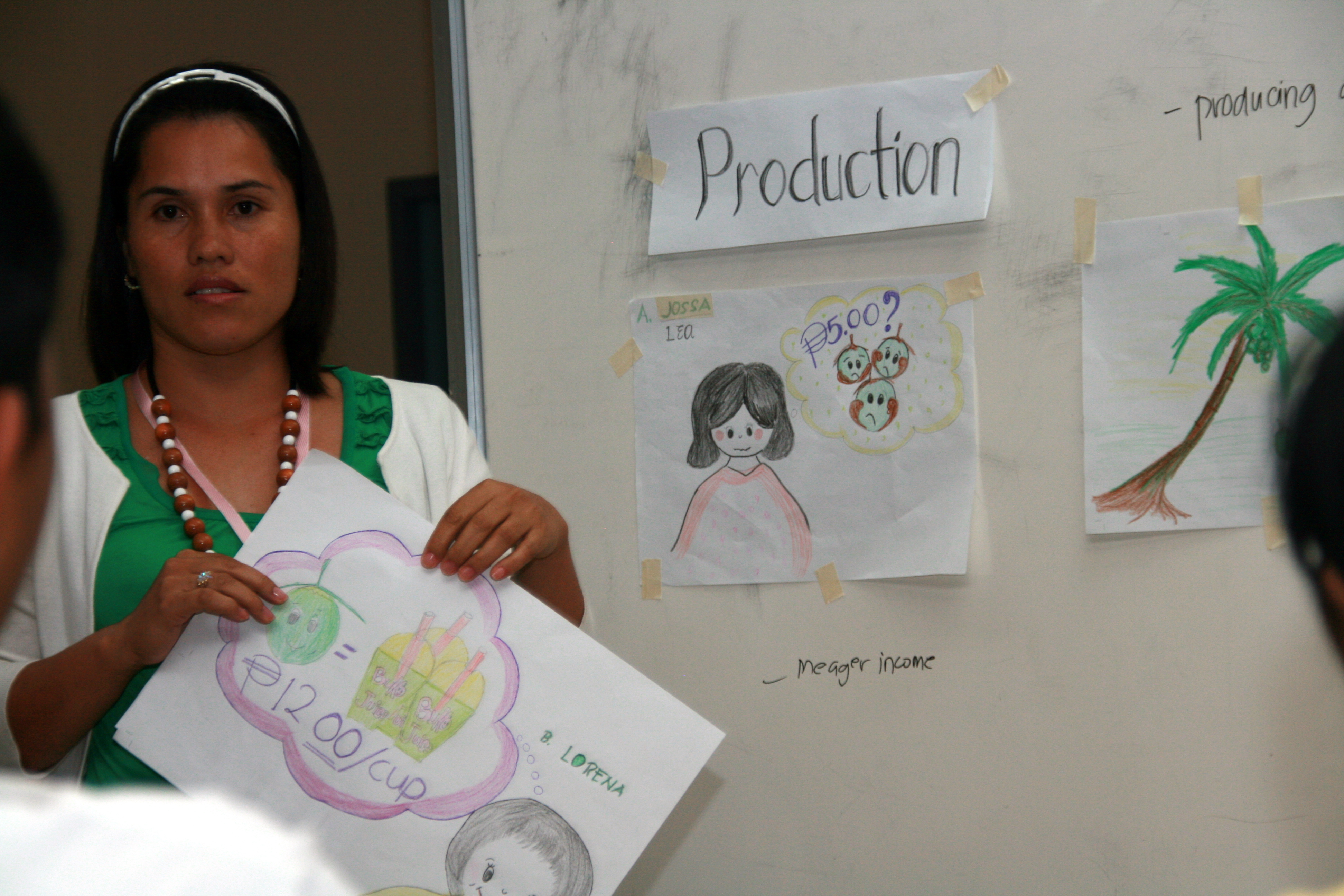
Participants spent the afternoon preparing to teach in small groups the lessons they adapted yesterday, which last night we retyped and augmented with discussion questions. With props, games and pizzazz, groups taught their fellow participants about production and price and competition. Though their lessons were identical in some cases, pedagogies differed, underscoring the Barefoot MBA’s flexibility and adaptability – and reminding us how far we’ve come. Students articulated what they learned: know your audience, make them comfortable, be prepared, be flexible, don’t be distracted by details, practice. Practice, practice, practice.
Tomorrow we’ll continue to practice teaching, giving students as many opportunities as possible to practice what they’ve been learning before heading into the field on Friday to teach some of NWTF’s borrowers.
BACOLOD CITY – Day 2 was livelier than Day 1, due at least in part to additional comfort and interaction among participants. Today’s topic was also more tactical: We spent today adapting the Barefoot MBA to local specifications.
We designed the Barefoot MBA to be adaptable to anyone, anywhere, but the lynchpin of its success depends on the quality of its adaptation. Today was participants’ opportunity to demonstrate their local expertise and apply it to their clients’ businesses. They were quick, sharp and eager – and by the end of the day made real progress toward adaptations to use with their clients.
After reviewing yesterday’s learnings, we started the day with an overview of how to adapt the Barefoot MBA’s lessons. Using lessons included in our adaptation guide, we talked with participants about key issues to consider when adapting the Barefoot MBA’s lessons: What names are relevant? What businesses are appropriate? What market prices make sense to locals?
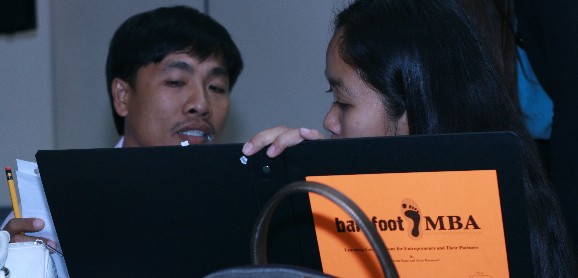
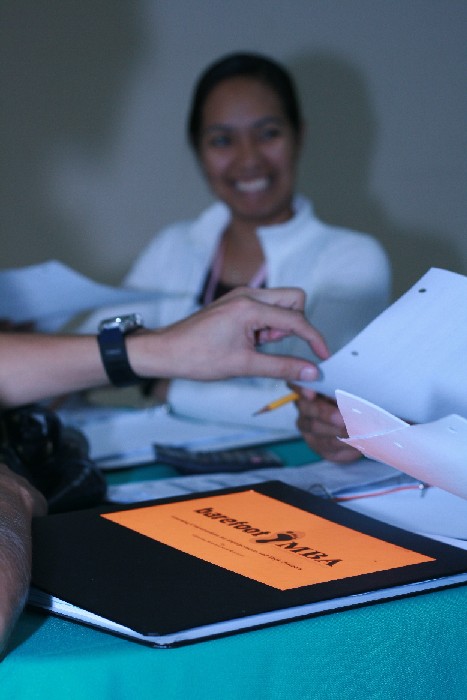
Participants adapt the Barefoot MBA
As a group we adapted three sample lessons: saving, investing and spending. We replaced Thai names, items and prices with blanks. We then filled in the blanks one by one, Madlib style. Participants were comfortable adapting the stories by lunchtime and spent the afternoon working in groups of two or three to adapt the remaining stories to local specifications. By the end of the day, each small group had adapted three to five stories, and collectively we completed two full Philippine adaptations and made significant headway on several more.
We spent a long evening inputting participants’ handwritten worksheets, quickly understanding teachers’ appreciation for neat handwriting. By midday tomorrow, we’ll distribute to each group a customized adaptation based on their work today so they can practice teaching lessons most applicable to their clients.
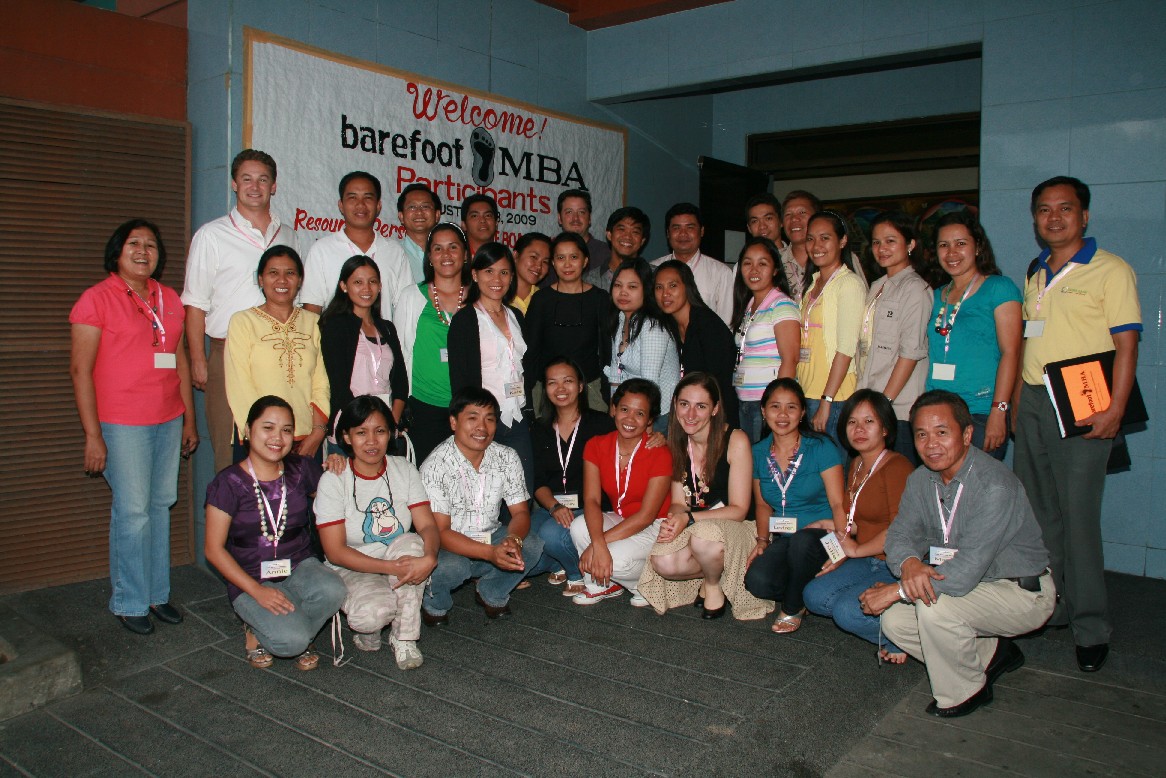
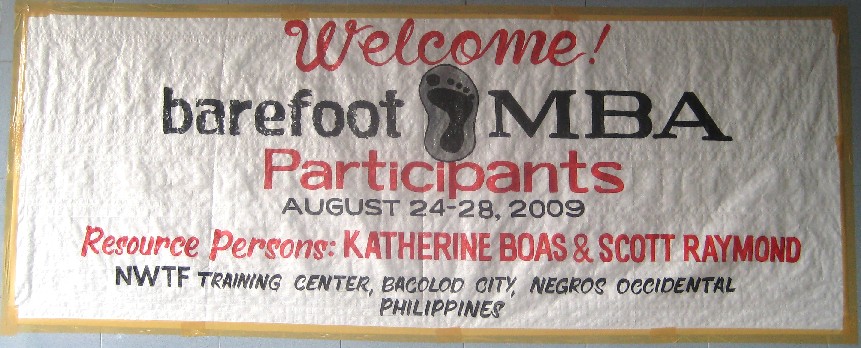
BACOLOD CITY – A large, bold banner at NWTF’s training facility extends a warm welcome to us and the Barefoot MBA. An hour before our scheduled start time today, we arrived to a large multipurpose room – and a handful of students eager to get an early start. We were off to a good start.
Our participants come from a host of organizations in the Philippines plus one in Cambodia. They represent a mix of ages, genders and locations, emphasizing that the Barefoot MBA can apply to anyone and that we all learn from each other. Some knew little about the Barefoot MBA besides its name. Others had poked around our website. At least one had even become a fan on Facebook. All were curious to learn more.
And learn they did. We spent most of the morning giving an overview of the Barefoot MBA and each of the seven topics we’ll cover this week: Student selection, lesson selection, timing and schedule, adaptation, teaching lessons, measuring student outcomes, and follow up / monitoring progress. By the time the participants articulated their takeaways from the morning, it was clear just how much we’d conveyed in a short period of time. Different students have different needs, one participant said. The Barefoot MBA is for everyone, said another. We couldn’t disagree.
We spent the afternoon on student and lesson selection, grouping the participants by organization so they could discuss how to apply their learnings to their clients. Participants saw that though their organizations and clientele differ, some themes were common. They saw, for example, that farmers and manufacturers have different learning needs and that it’s hard to learn investing without first understanding saving.
After a review of the day’s lessons, we enjoyed dinner as a group at a local seafood restaurant, where several NWTF board members joined us.
Our schedule is set: A week from today, we’ll start a four-day train-the-trainers workshop in Bacolod City, the Philippines, for about 40 MFI representatives from the Philippines and Cambodia. We’ll give conceptual and hands-on exposure to our basic philosophy, adaptation, and teaching so participants leave ready to implement the Barefoot MBA with their home organizations. We look forward to meeting the lenders and getting started!
We hope to send updates from the ground and encourage you to follow along, via blog, Facebook (become a fan!), and/or Twitter.
As we mark the second anniversary this month of our Thai pilot, we’re excited to announce a return trip to Southeast Asia with the Barefoot MBA, this time to a train-the-trainers workshop in the Philippines next month. Thanks to support from the Global Initiative to adVance Entrepreneurship (GIVE) and the Negros Women for Tomorrow Foundation (NWTF), we’ll work with representatives from microfinance institutions in the Philippines and Cambodia to adapt and implement the Barefoot MBA. Stay tuned for more details as we finalize them.
Confirmation of our Philippines workshop caps off a year of progress for the Barefoot MBA — and represents how far we’ve come. Since our first anniversary, we’ve continued to broaden and deepen our partnerships with micro-lenders and other organizations with access to entrepreneurs hungry for basic business education. For example:
Our original partner in Thailand, PDA, successfully finished a full Barefoot MBA implementation in Lamplaimat, where our original pilot occurred, and is considering new ways to expand and customize the program in other villages.
In Guatemala, we strengthened our partnership with a local university and Grameen Bank through teaching the Barefoot MBA’s lessons and translating them into the local dialect to improve efficacy, thanks especially to the tireless efforts of a recent Stanford graduate through the winter of 2009.
A partner in India created the first of what we hope will be several adaptations for that country, demonstrating the power of collaboration and the potential of sharing.
We’re in the early stages of discussion with others, including some in Uganda, Cambodia and the United States, about how best they can use the Barefoot MBA.
As always, that’s just what we know. Our blog-turned-website continues to get hits from every inhabited continent, and we continue to hear second- and third-hand of others adapting the Barefoot MBA to their needs.
We look forward to another year of progress ahead — and, as always, to continued support and feedback from you. In the meantime, we invite you to join our fledgling social networking efforts by becoming a fan on Facebook and/or following us on Twitter.
Another update from Anita at PDA, this time on training the trainers, which will enable exponential expansion of the Barefoot MBA in Thailand:
On May 23-24, PDA ran a Train-the-trainer session of the Barefoot MBA. Fourteen PDA operations staff from three PDA centers were taken through the Barefoot MBA Phase I curriculum, both as participants and then as trainers to critique the lesson content and discuss training delivery. We will soon be ready to roll out training to villagers from around these three centers!
It’s a treat to hear from Anita, our Thai translator, steward of the Barefoot MBA at PDA, and general goodwill ambassador for the program. Anita and Laura, the PDA intern from Michigan State, have made great progress deepening and broadening the Barefoot MBA’s reach at PDA. We’ll post photos when they arrive. Meanwhile, Anita writes:
We have been busy working to dramatically increase the number of our Village Development Partnership (VDP) projects and engaging the private sector. … We are looking at incorporating the Barefoot MBA into our VDP model. As we give villagers access to credit to start/expand their businesses through the Village Development Bank, we also offer them skills to help them succeed in their businesses through the Barefoot MBA.
Laura and I just spent 3 ½ weeks in the PDA Lamplaimat center this March, where you were based last time. We went through the remaining 13 modules of the curriculum, along with Khun Prahat, the head of the VDP program (he was previously also the center director). Of these, we decided to discard 3 as they were already covered by other training run by PDA. Working with Somthin (who helped us last time), we adapted and translated the remaining 10 modules, grouping them into 4 learning sessions. Of these, we tested out 2 in pilot sessions, including as many people as we could from the first two pilot sessions. They were also a success, despite a massive storm preventing many of the participants attending the second session!
We are calling the sessions based on your curriculum “Barefoot MBA Stage 1: Introduction to Business” and this will be offered to all villagers who are interested in setting up/expanding a business, and to members of the Village Development Bank committee. We are incorporating two PDA training sessions, which teach how to write a business plan and how to create a budget over 1-2 days. These are very in-depth classes which are designed to give participants the actual tools they need to start a business, so we are only offering them to villagers who are very serious about setting up a business. We are calling these classes “Barefoot MBA Stage 2: Advanced Training.”
We won’t stop here. We will continue to work on expanding the Barefoot MBA at PDA to include “Study Abroad,” “Internship” and “Networking” stages.
As you can see, your work with us almost two years ago has been invaluable in helping us to get started on offering villagers what they desperately need: business knowledge and skills!
We’re amazed at what can happen with a little patience. We’re happy to announce that we now have an adaptation for Rajasthan, India. While it may not fit the entire breadth of needs of such a large, diverse country, it is an answer to the requests we have received for adaptations in India.
This is yet another example of the collaborative work of individuals and the value of sharing the products of that work. We could not have adapted the curriculum withou sufficient knowledge of local customs, and Pulkit, the author of this adaptation, likely would have spent his time building a teaching tool from scratch. As always, we encourage people to share their work, and we will continue to do likewise.
Thanks to Pulkit for his work, to those who have shared the lessons in the Barefoot MBA with others, and to those who share their adaptations with us.
Progress independent of our day-to-day effort continues, this time back in Thailand with PDA.
We’ve been in touch with Laura, an intern from Michigan State who’s expanding the Barefoot MBA’s reach in Lamplaimat, where we piloted the first lessons. During her seven-week internship, Laura has been adapting and implementing several lessons with PDA.
She writes:
The first three weeks of the internship I was working out of the PDA Bangkok office, and just getting acquainted with the organization. I made a couple site visits up here to Issan to check out some VDP villages. For the second half of the internship though, Anita and I have been making the trek to Lamplaimat for the past couple of weeks, and working on adapting/translating 8 more modules. In most cases we’ve combined at least two modules together, creating a session that covers two related topics. Because you guys have already created the lesson outlines, the hardest part has just been coming up with activities that will keep the villagers involved and hold their attention. For one of the lessons I wrote a skit about loans and interests, and we’ve made up an activity about selling fruit in the market to teach about specialization. I’m still working on writing examples for the Planning and Records lesson. We’ve created some basic charts to show the villagers, and we want to be able to walk them through how to keep their records using them.
Laura is keeping a blog complete with photos and stories that harken back to our time in Thailand. We look forward to her regular updates — and, ultimately, to her final report.
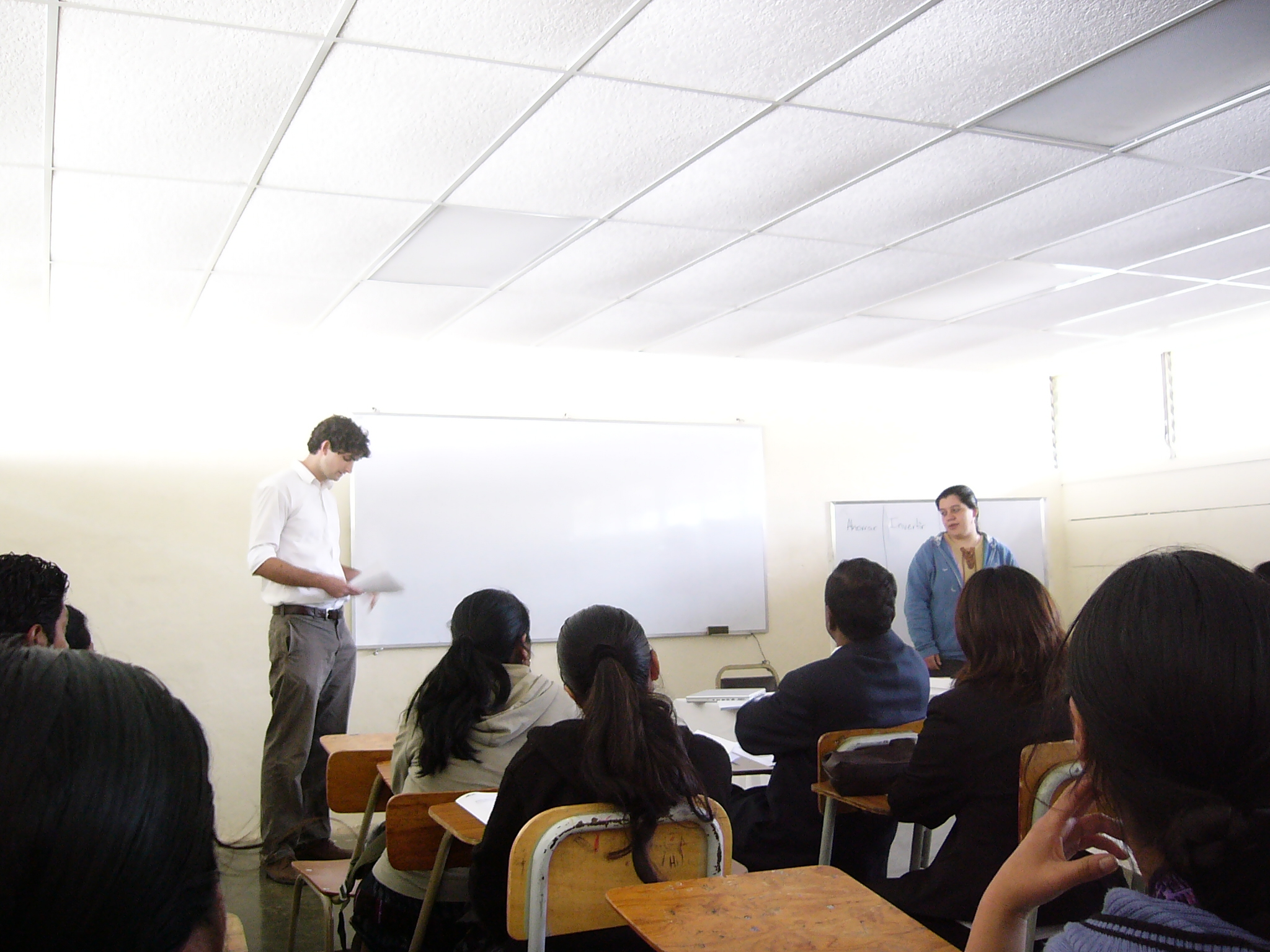
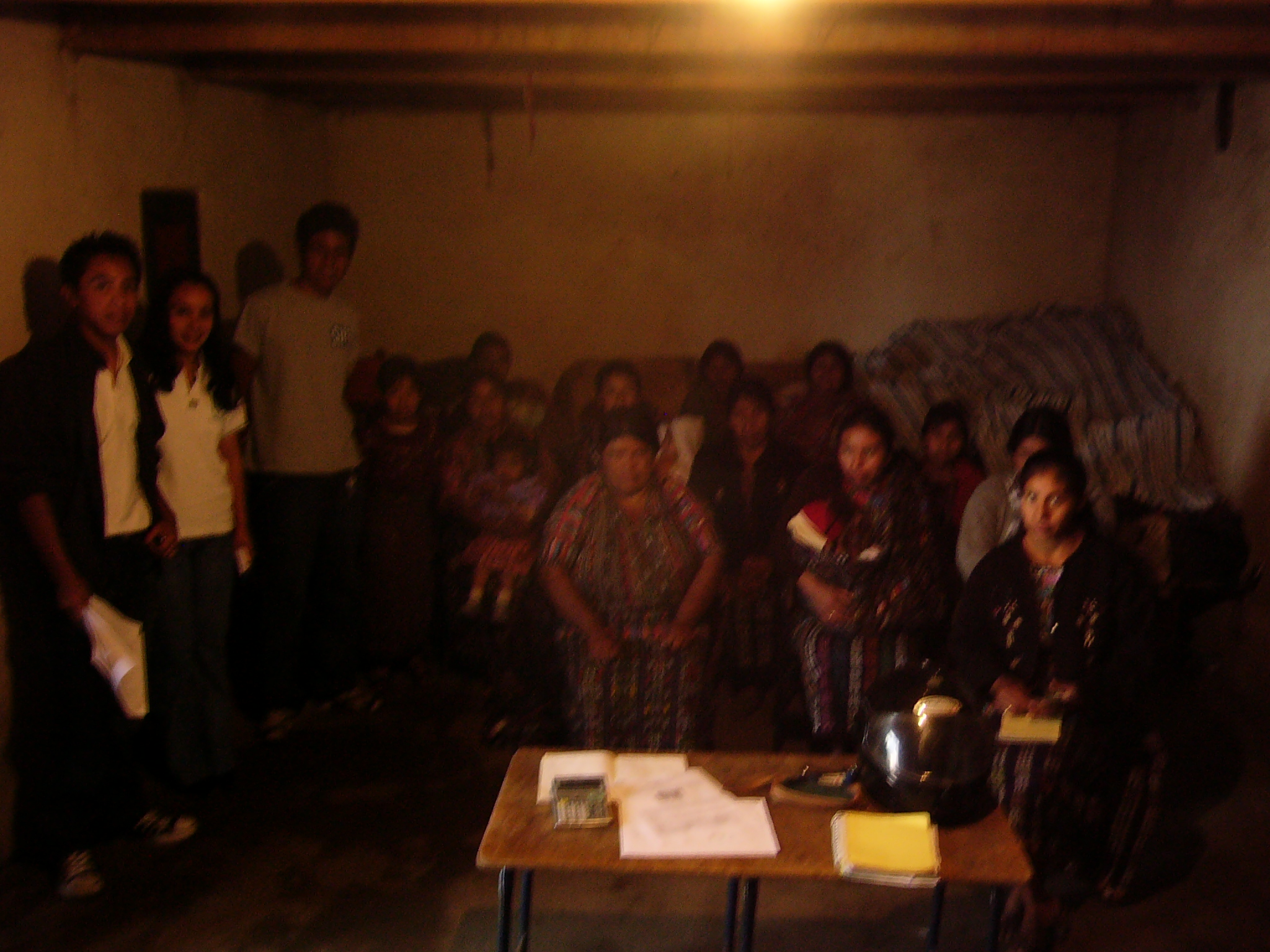
Today we began the first of a series Barefoot MBA basic business education courses with a group of Grameen Bank clients nearby Los Encuentros in Il Paraiso Guatemala. I, Ottavio Siani, and 3 students from the Universidad de Valle de Guatemala-Altiplano, Policarpo Chay, Josue Bocel, and Shirly Cano, arrived at 9 a.m. after searching for the small house where the Grameen bank meeting was taking place. We sat in for their biweekly micro-finance meeting, complete with the saying of the Grameen mantra. Oddly enough, in the background the radio was playing “Take Me Home Country Road” during their meeting and after we were introduced, “Fortunate Son” by Creedence Clearwater Revival came on. (Seriously.) A better song could not have been chosen.
After a brief introduction, each of the 3 students taught one of the first three Barefoot MBA subjects, saving, spending and investing, taking questions in between subjects.
After the introduction we realized that though the group understood Spanish the classes would be much more successful if they were translated into Kaqchikel, the local Mayan language. Fortunately Josue speaks fluent Kaqchikel and was able to translate, which increased the amount of participation drastically. We finished in 45 minutes and, luckily, were asked to come back for their following meeting to teach opportunity cost and cost-benefit analysis.
We have begun practicing the next two lessons and are very excited for next week.
We begin the new year with exciting news about the Barefoot MBA: UVG will teach the Barefoot MBA to a group of Grameen Bank clients starting later this month. Our partners at UVG are excited, and we are too. As they prepare to continue the Barefoot MBA’s implementation in Guatemala, we’ve posted agriculture and tourism adaptations to the Curriculum page.
Best wishes for a new year of peace, knowledge, independence, health, prosperity, and success.
It’s hard to think of a more rewarding gift than the following update from Guatemala. Just as parents smile from within as their children achieve first moments of independence – a first step, first sentence, first job – it is with great pride that we look back and see the Barefoot MBA beginning to take its first step of independence. Rather than spoil it with commentary, we include Ottavio’s e-mail, with his permission, here:
SOLOLÁ, Guatemala, December 9 – I am now at the beginning of my fourth month here in Guatemala. My Spanish has improved dramatically, which has allowed me to move around much more freely. Language is quite a powerful tool.
Finally, after much organizing, consternation, etc. (I have been wielding the phrase that you have used, don’t let the perfect be the enemy of the good, like an ax) we have executed the first (saving, spending and investing) of a series of basic business education courses here at la Universidad de Valle Altiplano in Sololá. Nearly 40 people showed up and paid 10Q ($1.50) to attend the course. 34 of the 39 people were women; all owned businesses, and over half were teachers who said they were planning on bringing the lessons to their classes and homes. It really was a joy and fortunately there was a lot of interest in the rest of the lessons that the Barefoot MBA has to offer.
My biggest fear going into the day was that the lessons were going to be too easy. While I think that the lessons could have been a little harder (the next subjects are inherently more difficult), fielding a question about how saving money in a bank is useless because you can’t earn any interest reassured me that there was a need for this kind of education. After going over what the result of saving 50Q every two weeks for 10 years would be and how much interest you would earn from your savings (people were certainly shocked to see the results of this exercise) there was agreement that it was a good idea. The activities that we designed worked great (we broke into groups and proposed different scenarios and brainstormed how one should deal with them). Group participation, it seems to me, is very helpful.
Going forward, in addition to offering additional lessons on Saturdays, we are going to continue working with the Grameen Bank (the 10 or so other micro-finance organizations I met with are moving much more slowly. Processes with them are pending) in order to get a group of their clients to come to the university a few times to receive all of the lessons. We plan on using this group to help determine the effect this type of education has, if any. Hopefully we will be able to gather some anecdotal evidence that shows that the course is having a positive effect. Any advice on how to go about this would be great.
We continue to field requests, mostly by e-mail, from those interested in using the Barefoot MBA in new places. We provide whatever support we can, but often we don’t hear much in return. We’re thrilled, then, to share concrete stories of progress. Here’s one:
Ottavio, who finished his undergraduate work at Stanford in June, contacted us before heading to Guatemala for six months to work with the UVG and continue the translation and adaptation Scott started in March. UVG plans to partner with Grameen Bank for two sessions on saving and investing, one in November preceding an information session on microlending and one in December for a smaller group of Grameen Bank clients.
As the world ushers out the end of the worst economic year in recent memory, we’re more encouraged than ever about the future of the Barefoot MBA. Through partnerships with organizations with existing infrastructure and communities, the curriculum is reaching those who need it and continues to spread even without our hands-on support. We hope those who learn from the Barefoot MBA now internalize the lessons and pass them along to their own families and communities, virally enabling better business decisions — and in turn better lives.
A year ago today, we arrived in Bangkok with cautious optimism that the basic business lessons we’d distilled would be adaptable and at least somewhat relevant to the villagers we’d just traveled around the world to meet. That cautious optimism quickly turned to vigorous enthusiasm for the global applicability of the Barefoot MBA as a catalyst for improving the business savvy of undereducated entrepreneurs and as a tool for those who support them. We spent the next weeks and months developing the Barefoot MBA – refining the curriculum, creating an adaptation guide, and sharing our work with the world’s foremost entrepreneurs – with the hope of achieving our goal of reaching every inhabited continent by July 2008, a year after our first pilot.
July has arrived, and we’re proud to report progress on nearly every inhabited continent:
In Asia, the Population and Community Development Association, our first partner, continues to use the Barefoot MBA in its regional development centers throughout Thailand. We’ve created a version for urban Thailand based on market information in Bangkok. We’ve also sent the Barefoot MBA to a leading social entrepreneur we met at the Schwab summit who expressed interest in using it in northeastern India and an NGO that provides livelihood training for poor urban women in the Philippines. A recent traveler to Bedouins in the Jordanian/Palestinian desert remarked on the curriculum’s applicability there and is discussing its application with local groups.
In the Americas, Scott traveled to Guatemala, where he and locals translated and created two adaptations of the curriculum for agricultural and finished-goods businesses in rural Guatemala. We’ve also shared the Barefoot MBA with a social service organization in Brooklyn, New York, and have spoken with similar organizations in the Bay Area, California.
In Africa, a forestry company in Uganda is using the Barefoot MBA to teach rural contractors and foresters and is looking into passing it on to local savings and credit cooperatives.
Globally, we’re developing partnerships with micro-lending organizations that can supplement their financial capital with intellectual capital, providing tools to their borrowers just as venture capitalists give tools to their investors.
And that’s just what we know. Our humble website has been visited by people from more than 40 countries, including at least 2 countries on each inhabited continent. We continue to encourage users of the Barefoot MBA, regardless of location, to share their stories with us as we endeavor to spread the Barefoot MBA to every aspiring entrepreneur.
In the meantime, we have high hopes for the coming year: more translations, more adaptations, evangelizing the Barefoot MBA through publications and conferences, potential partnerships with microfinance and other related organizations, and, as always, continued support and feedback from you.





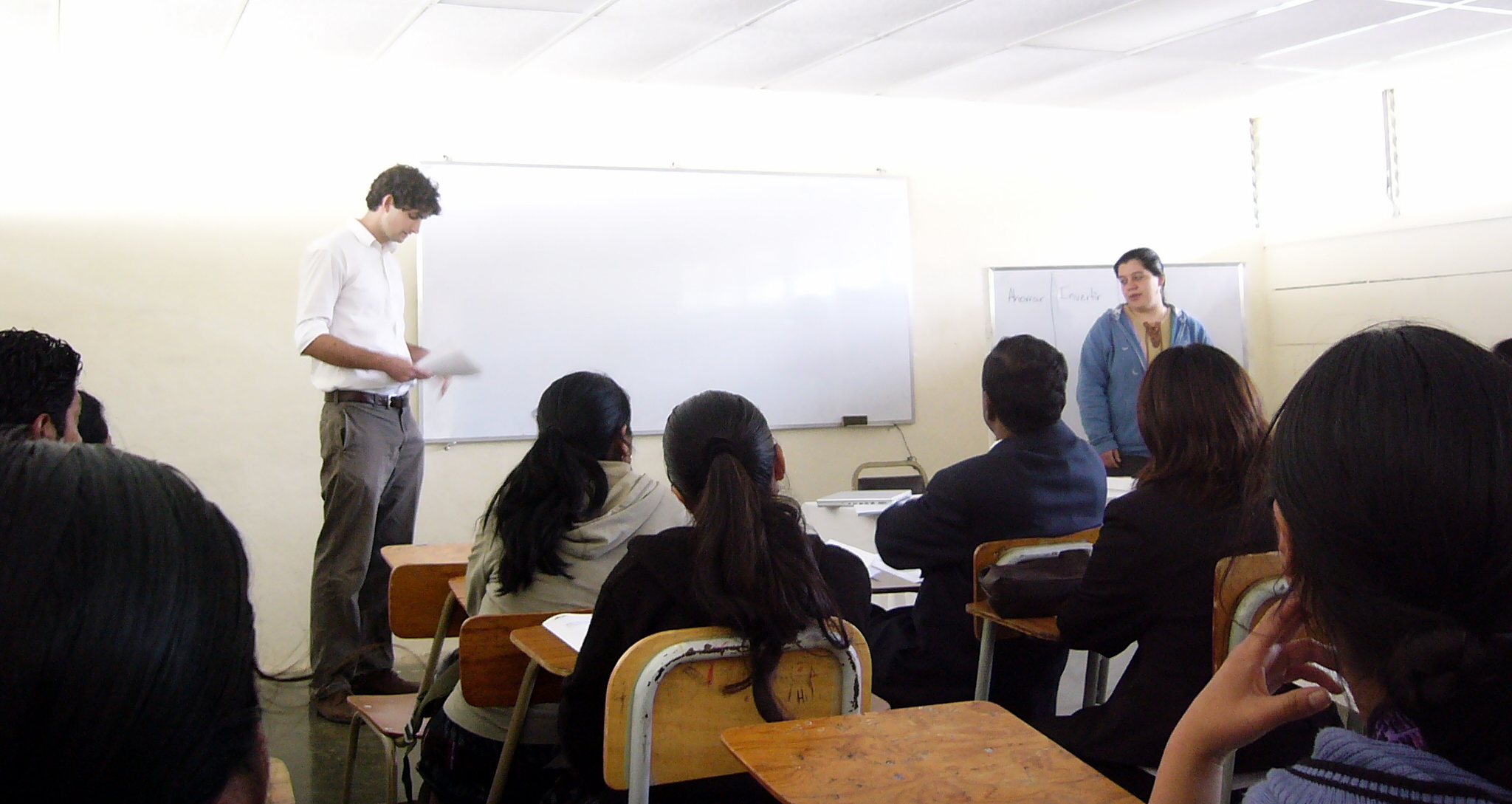
 Barefoot MBA