Blog

Final preparations

LAMPLAIMAT, July 24 – We have an early start this morning, beginning to go through the lessons in English and Thai, make any final adjustments and then, as our educational experts remind us, face the 60 percent of teaching that is process: how the lesson is taught.

Our local advisors believe that teaching by story-telling, while interesting, hopefully memorable and not too long, might still be boring. To make the process more interactive than a story and a discussion are, we’ve decided that a game might help. And, in the area of learning business through a large, group game, Stanford has once again provided us with useful experience. (The first time many of us met at Stanford was at a pre-term session where we were assigned various roles in a group, and different groups competed against each other to produce and sell greeting cards. The discussions that followed covered topics from ethics to teamwork, planning to leadership.) Drawing from that experience, we’re creating two games, one for investing on the first day, and another that will incorporate two lessons, production and marketing, on the second day. Our goal is to turn the stories and discussions, which are still somewhat more conceptual than our audience would like, and add an aspect that is more applied, more tangible.

As we slowly go through the games, we review the overall learning goals (making sure they are consistent with the players’ goals) the rules, the answers to potential questions, and where we will and will not exert control of aspects of the games.
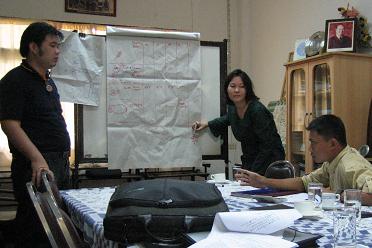
Final preparations - Lamplaimat

Anita, our incredible translator (and CSR officer at PDA), manages to facilitate the day in two languages, keeping all parties involved and informed. Before we even finish the first game, the PDA staff comes up with an idea for a second game that incorporates the marketing and production lessons into a game of making and selling baskets made of paper strips representing bamboo. We’re delighted to see how well this is coming together: Our lessons now have lesson plans, an outlined agenda and formal teaching notes – and, perhaps most importantly, the support of everyone involved.
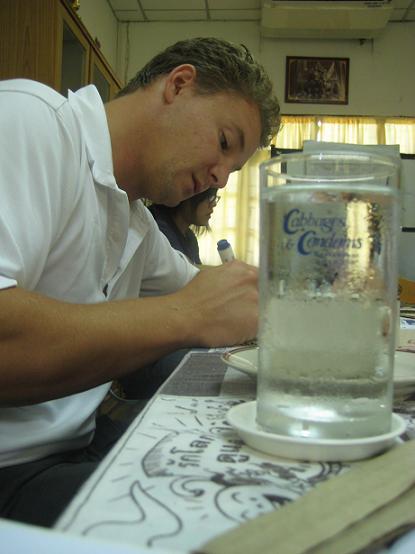
Scott creates game pieces

Tomorrow we’ll finish writing the basket-making game and test it with some of the staff here at the Lamplaimat center. Then, at 5 p.m., the show begins: our students arrive and, ready or not, the Barefoot MBA leaps from the page and becomes real.

LAMPLAIMAT, July 25 – Our test with the staff goes better than we imagine. Their creativity and skill with scissors and pens produces paper baskets more intricate and functional than we would have expected. (We assumed they would draw, color and cut out basket shapes; instead, they assembled three-dimensional bags with staplers, tape and paper, including exterior pockets, multiple color options and different handle lengths.) The feedback we receive is helpful.The questions the staff members ask are insightful for what our activity contains and what it does not.

We spend the afternoon making a few revisions. Soon, 5 p.m. arrives, and, slowly, so do our students.
Context

LAMPLAIMAT, July 23 – After a four-hour van ride, we make it to Lamplaimat to learn that a nearby village is having the first meeting of its Village Development Committee, the group PDA gathers to lead a village’s Village Development Bank. (This is more relevant to our host organization, PDA, and its going into rural villages to introduce and encourage villagers to create their own banking system, grow their local economy and pull themselves out of poverty – a far more empowered state than calmly waiting for the next round of NGO handouts and tolerating illness, poverty, lack of education and deteriorating village social conditions. This isn’t a forum to detail PDA’s work, or our high opinion of what it’s doing, other than as context to testing our curriculum. For background on our project, see the links in the sidebar to the left.) We hope the meeting will provide further insight into the mindset of villagers who come together to lead new initiatives in their village and begin the journey out of debt and away from subsistence living. We’ve come to meet them, to listen to their questions of process of the formation of a community-owned village bank and to better understand the individuals who will be receiving a Barefoot MBA, or at least the precursor to such a degree (no, it’s not really a degree, but a set of concepts we hope will help in their pursuit of a better life).

Village Development Committee meeting

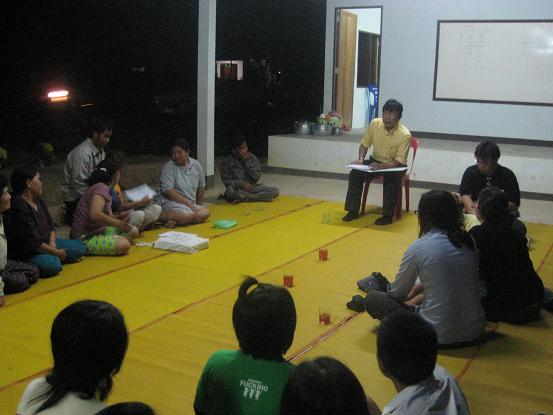
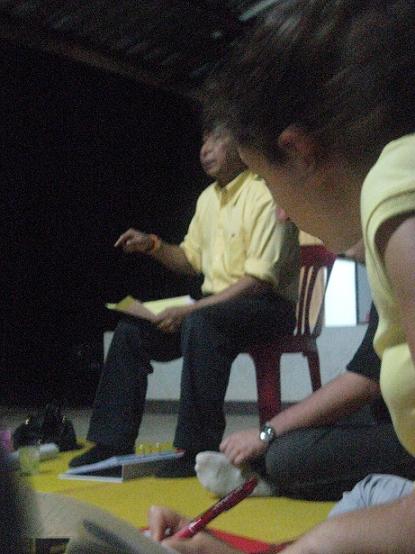
Lightning flashes in the distance. We listen as the villagers review the purpose of the 24-member committee and then discuss the specific responsibilities of each sub-committee. We hear their confusion about bookkeeping (our classmates had similar questions in Accounting), we see the youth committee’s enthusiasm about running a garbage recycling business (similar to our classmates who passionately chased idea after idea, trying to turn each into a profitable startup) and we saw the pointing of fingers as nobody knew who had the documents outlining how they planned to allocate the funds they would receive from the Village Development Bank (we’ve all had one of those moments).

Khun Prahat talks, Katherine listens

As bugs continue to swarm around the fluorescent lights above and fall into our juice, we’re struck by the similarities of questions heard at Stanford and those asked here tonight. That’s not a comment on either group; rather, it’s a somewhat reassuring notion that, separated by so many factors, we’re truly not that different after all. Sadly, we’ll have to have that comment translated to share it with the villagers.

Just before we break for dinner, around 8 p.m., another representative of PDA changes the topic to something more serious. Recently, a young teenager accidentally became pregnant, the young father to-be denied responsibility and her family disowned her. She’s gone to Bangkok, and that’s the last anyone’s heard from her. The message here is that safe sex and condoms do more than prevent disease; they also keep families and communities from breaking apart. And, just as PDA provides the tools for the villagers to improve their financial lives, PDA also provides the tools for these villagers to improve their health. Amazingly, the staff members of PDA have built up enough trust with these villagers that few are turned off by talk of safe sex and condoms.

They learn here together at this small community center, a 20-by-30-foot slab of dusty concrete with a tin roof, one exterior wall and fluorescent lights that’s used for everything from community meetings to yoga classes. Elders and teenagers come here, ask questions, listen intently and walk away prepared to take action to move the village in a new direction.

We have partnered with PDA because of the trust they have developed with villagers here and everywhere they work. The community-education model is one PDA has shown to be effective here and one we trust will continue to work as new lessons are taught to villagers, whether about community organization, health practices or business education.

Synthesizing information

BANGKOK, July 19 – Back from Buri Ram province in the northeast, we now face the challenge of distilling the stories we’ve heard and businesses we’ve seen into a few key differentiating factors. Condensing two years of Stanford Graduate School of Business into 14 lessons was enough of a challenge over the past six months. (For background on our project, see the About and Executive Summary links in the sidebar to the left.) We now have to fit the lessons we want to teach into two Barefoot MBA teaching sessions next week, two hours on Wednesday night and two hours on Thursday night. From the curriculum we’ve already developed and the new information we’ve learned here, we must determine what is most important for these villagers to know.

What knowledge makes a successful business stand out? Empirical studies fail to provide an answer and instead leave plenty of room on entire bookstore walls dedicated to key business secrets – which, amusingly, seem to change about every six months. We don’t propose to have any more of an answer than the authors of so many ephemeral best-sellers. Instead, we have focused on the differences between what the few successful entrepreneurs here do and what everyone else does. It’s a bit like looking through time, when life was simpler and these questions had clearer answers. What business practices are essential to bridging the gap between success and everyone else (not necessarily failure, but subsistence living that keeps many villagers living in poverty and debt)? What information will help these villagers see the first small steps to growing their business, rather than the large gap between where they are and where they want to be? What is the common practice that could use revision?

We found answers in our discussions with entrepreneurs over the past weeks. The differences come in subtle but noticeable lessons. The successful people break from common practice. They take profits from rice farming, use some to replant rice for next year and then do something different. They use the remaining profit to plant a new crop, raise a pig – or fish, or frogs, or fruit trees. They test their own products and try to improve them. They talk to customers to determine what they want and make products accordingly. They join together with other producers of similar goods to collectively bargain for lower transportation costs to get their goods to market. And, most remarkably, they have a very precise knowledge of the financial status of their businesses, both in records and in their heads.

Knowing this, we have narrowed our curriculum of 14 topics to 3 or 4 we think we can pilot next week:– Investing (business growth)

– Production (value-add services available to existing market products and materials) – Planning & Records (tracking investment and business growth)– Marketing (understanding customers, explaining a product to them)

We’ve changed the business examples in each lesson to correspond to best practices we’ve seen this week and changed the figures to correspond to local market prices. Our curriculum will be translated this weekend, and next week we head back to Lamplaimat to work with the PDA employees who know these villagers and will teach the curriculum. Together we’ll go through the lessons and think of ways to bring them to life for our students, through role playing, discussion questions or even the dreaded business school cold-call.

Meeting our students

We spent two days in the Buriram province, where seemingly endless rice paddies are just a piece of the primary industry here: agriculture. The Buriram province is 380 kilometers east northeast of Bangkok, 68 kilometers from the Cambodian border.

Villagers here in northeastern Thailand, Isarn in Thai, are among the country’s poorest. They rarely continue in school past sixth grade. They send family members away to earn money to pay debts, sometimes through prostitution. They resist trust, a result of too many broken promises from government and ephemeral NGO handouts. But their spirits are high, and with modest loans and business training, they are learning to be self-sufficient.

PDA runs three centers in Isarn, with programs ranging from environmental awareness to HIV and AIDS prevention to democracy and rural development to business development. (For more information about PDA and our project, see the About and Executive Summary links in the sidebar.) The range of programs, businesses and people we saw gave us insight into the changes we need to make to our curriculum before we pilot it here next week.

Their stories are in the posts below.

Tuesday morning

LAMPLAIMAT, July 17 – They are the epitome of the barefoot entrepreneur.

Years ago, Khun Sombat received nine acres of rice paddies as a dowry. Water ran off the property, rendering it unproductive and leaving Khun Sombat with a choice: leave the land fallow and wait for help or figure out how to make the most of his misfortune by reviving the land.

He chose the latter.

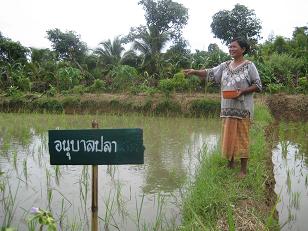
Today, the farm is so diversified and the land so productive that Khun Sombat and his wife, Khun Poy, need to shop only for cooking oil and the occasional spice. They grow everything else.

Bamboo, chili, eggplant. Catfish, tadpoles, tilapia. Chickens, cows, pigs. Corn, kale, coconut. Oranges, pumpkins, snails. Kraton, polamai, taro. More fruit than the English language can describe.

And, of course, rice. Lots of rice. Two methods of growing rice, one for greater quantity and the other for better quality. Plantings on the walls of the manmade pools whose floors grow the rice provide room and soil for additional farming.

Multi-use farm

Most of all, though, what Khun Sombat and Khun Poy have is patience and a hint of business intuition. They understand the rewards that waiting can reap. They know, for example, that spending 3,000 baht (US$90) on baby catfish now will mean 10,000 baht (US$301) in catfish sales in three or four weeks. A little patience and trust earns them 7,000 baht, a fortune in a region where the daily minimum wage is 148 baht (US$4.46) and the average annual income is 15,500 baht (US$467).

Khun Sombat and Khun Poy have sent their two daughters to college, a rarity in rural Thailand. They can afford to move to the city but prefer to live in their traditional Thai house, three walls and a roof covering a wooden floor hoisted a few feet off the baked red soil.

Others know that Khun Sombat’s farm is a model for success, but they have yet to copy it. Hesitant to wait for income, they prefer short-term profit and immediate cash. They illustrate the example Khun Mechai described to us last week, of people who sell at a loss just to produce income. They are precisely the population that we hope the Barefoot MBA can help.

Tuesday early afternoon

LAMPLAIMAT, July 17 – Those who frequent the center for AIDS- and HIV-affected people here do not look sick because the center keeps them up to date on medication – and renews their enthusiasm for life.

“Before, they wait for the day to die. Now they have a meaning for life,” the center’s director told us.

Even the name of the center, Celebrate the King Center, suggests hope. The center, the largest of PDA’s Positive Partnership Program (PPP), provides a home base for the 40 PPP pairs in Lamplaimat. PPP lends to people living with HIV and AIDS and their HIV-negative business partners as incentives to work together to improve their economic situations and to reduce HIV and AIDS-related stigma and discrimination.

The average initial loan size here is 24,000 baht. The repayment rate of 75 to 80 percent is lower than the average microloan because some borrowers succumb to their illnesses before they can fully repay their loans, an unfortunate reality in this line of work.

The center provides information on HIV/AIDS and business advice, mostly to women and mostly to people with no prior business experience. Its target population mirrors, and in some cases overlaps, ours, so we’re adjusting our curriculum based on what works for the center. For example, we learned that because our target population balks at theoretical learning, even our pedagogical approach of telling short, contrasting stories is not interactive enough. As a result, we are reworking some of our lessons into skits that students can perform.

Tuesday mid-afternoon

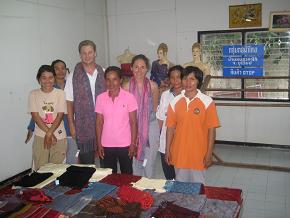
Silk scarves

BAN NONG TAKAI, July 17 – The women of Ban Nong Takai have been weaving silk for generations, but until 15 years ago, they hadn’t made it their livelihood.

In 1992, representatives from American Express started a silk center here, training the women in marketing, product development and other basic business functions. Today, the center nets more than 2 million baht annually (US$60,241), allowing the 38 women to split about 170,000 baht a month.

The women explain in detail the process for making their scarves, from feeding mulberry leaves to a basketful of silk worms to boiling the silk strands off the skeletons to dyeing and weaving vibrantly colored fabrics.

They know the ins and outs of their trade but not of the business behind it. For example, they operate as a collective for profits but not for manufacturing: two women who make red and blue scarves must dye each batch of red and blue thread separately instead of each specializing in one color and trading to improve efficiency. Again, there are lessons related to operational processes – skill specialization, demand planning, resource pooling – that might help these women increase their production levels with a little thoughtful reallocation of work.

Tuesday late afternoon

NANG RONG, July 17 – They call themselves the garbage bankers.

In fact, they are 8 teenagers, members of a 30-youth committee that runs a roadside garbage business. Using skills they learned from PDA, they buy garbage from a local village, sort it and sell it to the nearest town’s recycling center.

They store the garbage in a two-room warehouse that could pass for a house to the uneducated passerby. Inside, the goods are carefully sorted. (These kids put American recyclers to shame.) A wall of the interior room is adorned with boards that detail the resale prices of each item: 47-52 baht per kilogram of aluminum cans, 1.5-1.9 baht per kilogram of glass.

Since last April, they have made an aggregate profit of 15,000 baht. They split the profit between pocket money and tools that will improve their work.

Garbage bank leaders

PDA invests in youth because it knows adults will follow. And these are youth with dreams bigger than even the largest garbage warehouse. They talk knowledgeably about their garbage business, but when the topic switches to their aspirations for the future, they beam.

One wants to be a nurse, another a computer programmer. Chanthiporn Chanteth, the smiling girl clutching a notebook and eager to practice her English, proudly said, “I am a teacher.”

Wednesday

BAN BUH, July 18 – For Khun Hem, 74, making baskets to sell in the market is easy. Keeping up with demand is the hard part.

One 20-foot rod of bamboo makes about 20 baskets, which a cooperative sells in the market for 25 to 120 baht, depending on size. Each month, Khun Hem profits 1,500 baht (US$45), enough for Khun Hem to live but not enough to support his family. He also farms rice, vegetables and cows.

Bamboo baskets

Seven years ago, Khun Hem received a loan for his basket-making business from Nike, which partnered with PDA to invest 2 million baht in income-generating activities, including a village bank. Borrowers take out initial loans of up to 10,000 baht and also buy shares in the village bank, giving them personal incentive to see the bank succeed and all loans repaid. They must repay their initial loans within six months, at 12 percent annual interest, before borrowing again. The system works: since inception, Nike’s original investment has grown to 30 million baht from interest and reinvested savings.

Nike is just one of PDA’s partners here in the Jakkarat district. When it opened its first center here 19 years ago, PDA sought to develop the area’s economic, social and environmental situations. Locals were burning forests to create farmable land. They were sending family members away, usually to Bangkok, for jobs. Families were broken. Quality of life was low. Poverty and disease were familiar daily realities – accepted for lack of a clear solution.

With the help of businesses, the government, NGOs, experts, think tanks and the community, PDA has coordinated the reinvigoration of pockets of Jakkarat district.

It is here that we are focusing our first application of the Barefoot MBA, hoping to take what we learned at Stanford’s Graduate School of Business and apply the lessons, articulated in the simplest manner, to those who need them most: the world’s poor. We hope that sharing a few business principles, embedded in examples of other local business, can propel our students out of a life of subsistence living to one of less stress, better health and greater economic self-sufficiency.

Market research

BANGKOK, July 12 – Narissa has only a fourth-grade education, but in the five years she’s been in business here, she’s learned enough to support herself and her two children with the proceeds from one of the area’s busiest coffee stands.

Narissa

Narissa is one of five small-business owners we talked to yesterday to better understand the people for whom we’re designing our Barefoot MBA curriculum. The idea to do market research came from our meeting on Wednesday with Khun Mechai, who suggested we talk to small business owners in Bangkok and in Lamplaimat, the rural area where we’ll be next week. Armed with a list of questions and an appetite for stories, we walked the streets with Anita, PDA’s corporate social responsibility officer, who served as our translator.

Mr. Suyan

The entrepreneurs’ businesses varied, from fruit stands to lottery sales to hair salons. Their delight in their success, though, rarely did – a function in part of Thai culture but mostly of genuine yet humble pride.

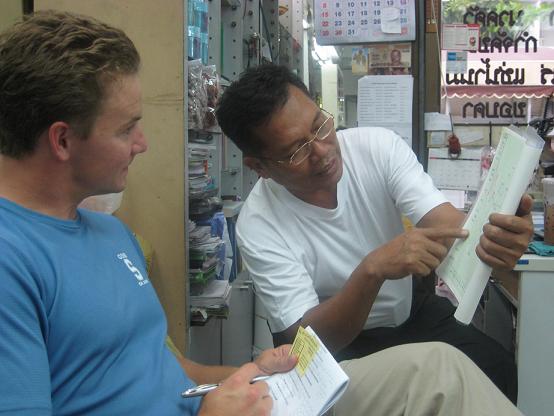
For example, when we asked Pan how much profit he earns from the hair salon he’s run for 17 years, he eagerly pulled out a booklet of colorful charts and graphs to show not only how much he earned last year (4.5 million baht, or about US$140,000) but also his monthly earnings over the last several years. He spoke of his love for his job, the importance of good staffing and the value of sharing resources with others.

Pan

Pan also emphasized the sine qua non of starting a business: will and knowledge.

As we’ve learned anecdotally and seen since we’ve arrived, the poor here generally have the will to start businesses, but they frequently lack what Khun Mechai consistently cites as the two keys to success: capital and knowledge. PDA takes care of the first, by running several programs that provide micro-loans.

By Pan’s account and Khun Mechai’s, that leaves knowledge as the major barrier to business success. We hope our Barefoot MBA curriculum begins to close the knowledge gap.

We hope to take care of the second, by providing educational lessons that contain business skills necessary for each of these businesspeople to further grow their businesses. The result, we hope, is that they will pull themselves out of poverty, inspire their neighbors and friends and provide better opportunities to their children and better care for their aging parents.

Though the lessons we’re teaching are ones that frequently are taught only to those who already have basic education, their fundamental messages are simple enough to teach anyone.

“Why does MBA have to be at the end of the learning curve?” Khun Mechai asked on Wednesday. “It should be at the beginning.”

Sawasdee!

(That’s half our Thai vocabulary: welcome!)

We’re looking forward to our return trip to Thailand and to keeping you updated on our progress through this blog, which we hope to update regularly. Please bear with us as we learn to blog amid spotty Internet service. In the meantime, check out the links on the left for background on our project.

Khorb koon ka! (The rest of our Thai vocabulary: thank you!)

Katherine