Amazing Progress

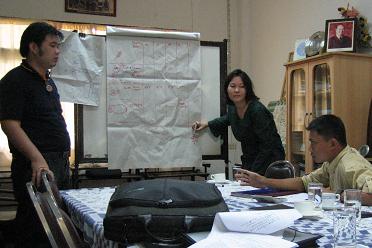
In Thailand, Katherine and I had to spend a significant amount of time thinking of local examples to fit each of the lessons and then finding local businesses that were similar.  While I expected to need to do a significant amount of research first, and then adapt the examples, and then translate the document, I’m quite surprised to return from my day to find two documents adapted and translated. The group of students and staff have done an amazing job of translating the documents and, with their knowledge of local business from the work they already do with these entrepreneurs, have also created two adaptations: one for tourist businesses (e.g., textiles and leather goods) and one for agricultural businesses.

I’ve been up late into the morning reading both documents and making some small changes to ensure consistency across all 4 adaptations we now have, but my excitement at the progress made today has kept me energized. It seems that tomorrows visits to small towns around the lake will be more for my own education than for purposes of adaptation. Instead of visiting and then adapting, I will be visiting some of the businesses already included as examples in the adaptations. My thanks to Maria Marta, Victor, and all the people at Universidad del Valle de Guatemala Altiplano who helped with this today. Again, amazing work.

Amaranth

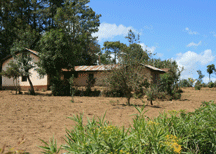
Amaranth Farm In fields around the campus, a group of women have come together to grow amaranth. As I am learning, amaranth has some incredible properties: each plant will produce 40,000 to 60,000 seeds seasonally, which are 13 to 15 percent protein (among the highest for any grain) and are high in fiber, calcium, iron, potassium, phosphorus, zinc, and vitamins A and C; its leaves are also edible, containing more calcium, phosphorus, and vitamin C than spinach; and it is resistant to the heat and drought, requiring much less water than corn and beans. Amaranth is native to Mesoamerica and has been cultivated here for approximately 7,000 years. Though it was nearly eradicated with the Spanish Conquest, it is being replanted in parts of Mexico and Central America.


Today I am visiting Victoria, who manages and operates an association of women who are making products from the amaranth plants. They sell a powder of amaranth seeds which is used to make a local drink or mixed with corn to make tortillas, and they make a natural, herbal shampoo. It takes three days to mix and settle the ingredients including the amaranth leaves, which they purchase for one quetzal (USD$0.14) each, into a liquid ready to be bottled as shampoo.

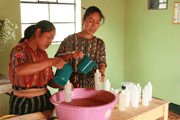
Florinda and Victoria bottling shampoo

Victoria and Florinda showed me the final product, and took the time to pour a bit of it into 8 ounce bottles, which they will label and sell for 12 quetzales (USD$1.63) each. They sell about 40 of these bottles per month, earning roughly USD$65 from selling shampoo. In addition to their other products, they are able to make a living for themselves and provide me with an example of how the support they receive in the form of business advice from organizations like UVG-Altiplano, plus a few small loans, means the difference between subsistence farming and a less stressful, more fruitful quality of life.

Measurement

The most interesting part of the adaptation process, both for me and for the staff at UVG Altiplano, is learning about the details of the local businesses in the markets. Discovering the costs of the goods, the history of the business, the competitive factors that exist in the market and trying to capture these to change the examples in each of the lessons.

We are simultaneously translating the curriculum and plan to produce two versions in Spanish – one for tourist businesses and one for agricultural businesses. (I hope to use my time on the airplane back to the US to translate these back into English for those interested).

In addition, we are building a tool to measure the outcome of the use of the Barefoot MBA. The staff at UVG-Altiplano has already done quite a lot of work with many of the small businesspeople in the markets, most of whom are women, to understand their lives, how they survive from their businesses, and where it may be possible to make small improvements. We are creating a tool to try to measure their businesses, what they sell, how many, and at what profit, to understand how their businesses function before the Barefoot MBA curriculum, so that we can measure similar aspects in the weeks and months following the Barefoot MBA. This will, we hope, finally provide a way to measure the outcome.

We heard from the participants in Thailand that they appreciated the lessons and wanted more. However, we do not know if the participants remembered the lessons, if they were able to make the changes they discussed, or if their businesses were more successful (as we hope). Our hope is that this tool will provide a more objective measurement of the outcome.

Sololá


Lake Atitlan

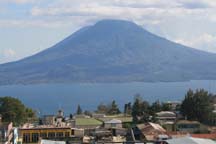
At 1,500 meters, Lake Atitlan lies in the highlands of Guatemala, surrounded by now-extinct volcanoes. The small villages surrounding the lake have distinct products in their markets and different colors of traditional dress (actually patterns and colors imposed by the Spanish as uniforms to help identify the different indigenous tribes and languages).

Sololá is located on the northern edge of the lake. The Altiplano (highland) campus of UVG has been working closely with the people here in Sololá. There is a new business incubation program for the high school and college students and their work extends to the local people, the majority of whom are Kaqchikel Mayas farmers and craftspeople who struggle to make a living selling their goods in the local markets, both through improvements in sustainable and organic agricultural practices, and now hopefully through improved business practices as well.

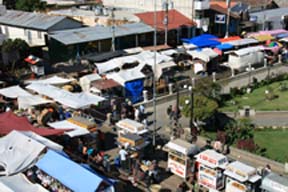
Market at Solola

The market in Sololá, unlike that in rural Thailand, serves two distinct groups of customers: tourists and other locals. As one vendor becomes successful selling a particular good, others copy it. Thus, there are 7 carts selling roasted chicken and potatoes, all next to each other. They compete on price, and talking to them (though not having tasted 8 pieces of chicken), it is difficult to discern a difference in the quality of their products or other aspects of their businesses. The price competition reduces their profits, and they now struggle to afford life’s necessities.


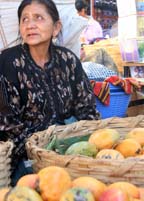
Maria is in a similar situation. Maria sells mangos and has been selling mangos in this market for 26 years. She learned to sell from her mother, who sold tortillas in a village on the southern coast of the lake. 22 years ago a space in this market opened, and she began to sell mangos here. She sells 300 to 400 on a good day, at 1 quetzal (USD$0.14) each. She makes enough to on a good day to get by, but never enough to save. Over the years she has seen more and more people come to this market to sell mangos, and she has noticed that she is able to sell fewer mangos.

Our Guatemalan Host

Taking the Barefoot MBA to as many places as we can has led me to cross paths with many things I might not have discovered without it. Certainly I have seen places and met people I might not have been able to access – rural parts of Thailand this past summer and rural parts of Guatemala in the days to come, incredible people in far corners of the world, and our own backyards, doing incredible things to help others.

I have also had the pleasure of meeting organizations pursuing similar goals of education, community and economic development, and poverty alleviation, our host being one such example.

UVG Logo

I am in Guatemala at the invitation of the department of engineering at the Universidad del Valle de Guatemala (UVG), and specifically one professor who has been working to add entrepreneurial aspects to the curriculum. Not only are they trying to provide a more well-rounded education for their graduates, they also have a campus on a former army base in Sololá that works closely with the people of the region doing work in job creation, economic development, and sustainable agricultural practices.

I have read their studies of the types of businesses owned and run by the rural women in and around Sololá, and have a sense for the numbers describing the income levels there. I have been told, and will see firsthand tomorrow afternoon, how these women struggle to provide for themselves and their families, many having lost their husbands during the 36 years of civil war that ended in 1996. Often times poverty is better understood when seen in person, and I hope to not only begin to understand it, but also how the Barefoot MBA can help.

While the document has not yet been translated into Spanish, we have, and will, conduct all our work in Spanish (or local dialects through Spanish translation). After all, the goal here is to help the faculty at Sololá understand how to use the curriculum so that they may continue to follow the adaptation guide after I have left and can continue the work in my absence. Hasta mañana.

Barefoot MBA goes to Guatemala

Two professors working in rural development invited us to travel to Guatemala to adapt the curriculum to help entrepreneurs there. This marks the second country, and second continent, for adaptation of the Barefoot MBA. In addition to adapting and translating the curriculum, Scott will test the Adaptation Guide to make sure it covers all salient details. Check the blog for updates as Scott gets to know the local markets and works with his hosts to adapt the Barefoot MBA.

New Adaptation Guide

After posting the Urban Thailand adaptation, we received helpful questions from our readers about the adaptation process suggested in the original Rural Thailand adaptation. In response to those questions, we created a more comprehensive guide to customizing and implementing the Barefoot MBA in new locations. This more complete Adaptation Guide addresses many of the gaps in the first document, and we hope it serves to help others follow in our footsteps in spreading the Barefoot MBA.

Response to SSIR article

We posted the following as a comment to the Stanford Social Innovation Review piece to which it refers:

We couldn’t agree more with “In Microfinance, Clients Must Come First,” by Datar, Epstein and Yuthas. Microfinance aims to alleviate poverty by providing access to credit to the world’s poorest entrepreneurs. But, as the authors allude, if merely giving money to entrepreneurs will propel them out of poverty, microlenders must be smarter than every investor in the world. That logic clearly is flawed. The assumption is that lending alone will achieve successful results. We know that’s incomplete. But lending, combined with business education, may be the key to propelling the world’s poorest entrepreneurs out of poverty.

Just as venture capitalists provide to their entrepreneurs to improve their chances of success, MFIs should provide additional, non-monetary resources for their borrowers. We recognize that the scope and scale of microfinance don’t make that a resource-efficient practice.

That challenge, presented to us by the chairman of a Thai MFI in January 2007, energized us to search for, and ultimately to create, a tool that could help entrepreneurs and MFIs begin conversations that would result in better business decisions – and better outcomes.

We created a tool, the Barefoot MBA, to meet that challenge. The Barefoot MBA seeks to give the world’s smallest business owners knowledge and concepts to empower them to make better business decisions and provide better lives for themselves, their families and their communities. The Barefoot MBA is intended to be used by existing organizations that have resources, relationships and infrastructure. It is a free, open-source tool, supported by us, available to all at http://www.barefootmba.org.

The Barefoot MBA’s lessons are taught through storytelling, the simplest, most time-tested method of teaching. Because they require no literacy, props or technology, they are accessible to anyone, anywhere. The stories are modular, their examples context-specific but adaptable; we include in our materials a guide to adapting the Barefoot MBA to other cultures and norms.

Microfinance debt is more useful with services that help entrepreneurs make effective, successful decisions with their new money. We hope to work with others in the field to help those trying to make ends meet bring those ends a little closer together.

Going global

Schwab summit

RÜSCHLIKON, Switzerland, January 22 – The Barefoot MBA was well received at the Schwab Social Entrepreneurs’ Summit, especially by those entrenched in the field. Social entrepreneurs from around the world, especially but not exclusively in microfinance, were excited about a free, adaptable tool to teach business skills to anyone anywhere.  We arrived at the summit hoping to find additional partners to adapt and implement the Barefoot MBA; we left with a stack of business cards of people eager to help – and with appreciation for and inspiration by their work as well.

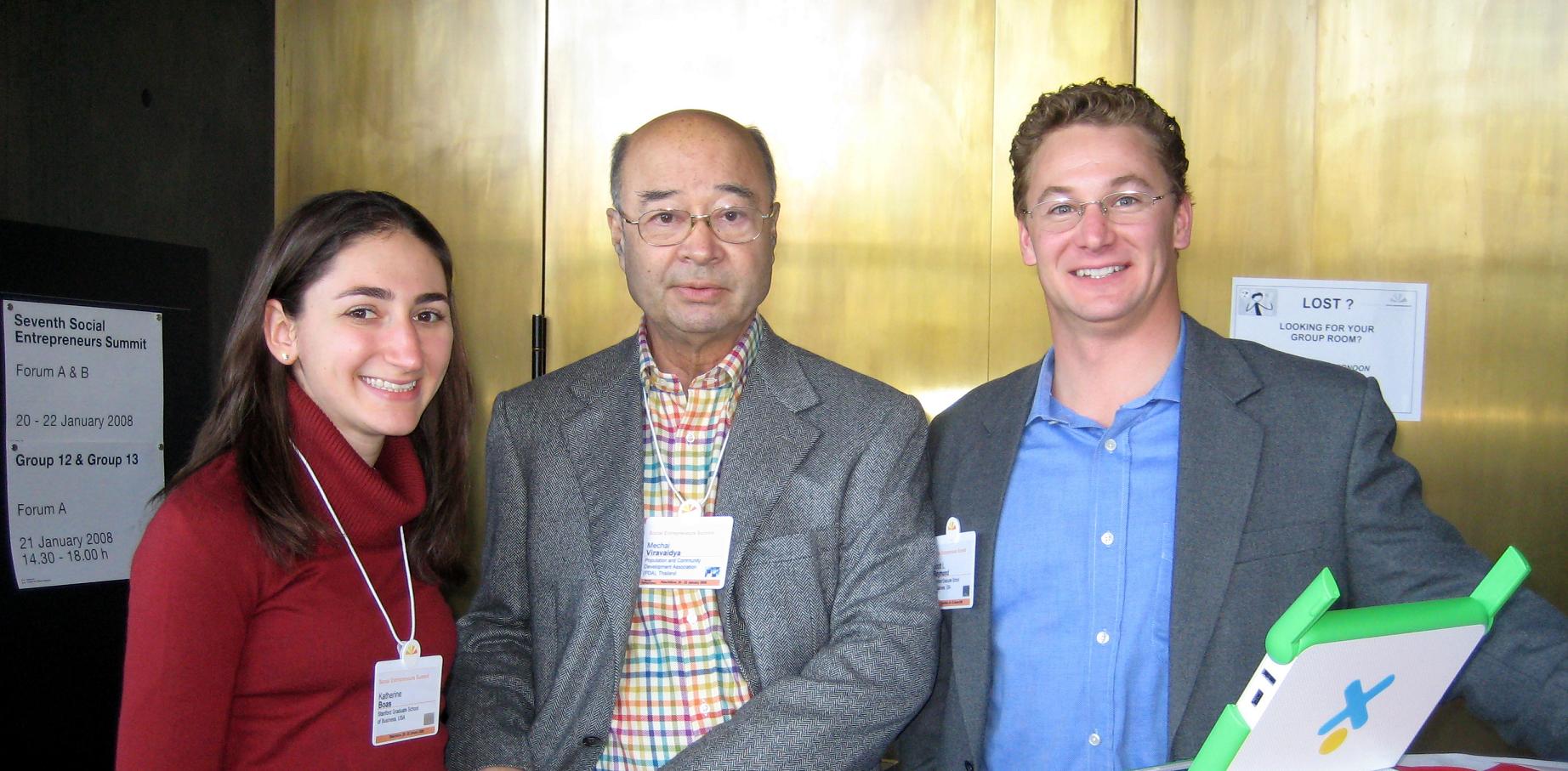
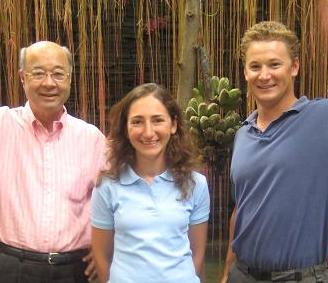
Katherine, Mechai and Scott in Switzerland

Among the more than 300 Schwab participants was Mechai Viravaidya, founder of the Population and Community Development Association in Thailand and our partner for the initial Barefoot MBA pilot last summer. Khun Mechai continues to be excited about the Barefoot MBA and already has incorporated it into many new programs.

We’re honored to be included in the Schwab summit and grateful for the opportunity to attend. We look forward to continued conversations with those we met in Switzerland about how they can use the Barefoot MBA and how we can learn from each other.

Joining the world’s social entrepreneurs

We were invited to present our work at the Schwab Foundation for Social Entrepreneurship‘s annual Social Enterprise Summit near Zurich, Switzerland, in January 2008. With Mechai Viravaidya, the founder of the Population and Community Development Association (PDA), with whom we worked last summer, we will present our work adapting and piloting the Barefoot MBA for rural Thai villagers. Some 300 Schwab Foundation Fellows and social entrepreneurs from around the world attended the 2007 Summit.

In Switzerland, we will have the opportunity to meet with leading social entrepreneurs in small-group and one-on-one sessions to explore ways to improve the curriculum and replicate the Barefoot MBA around the world. We plan to look for one or two large partners with whom we can work in February and March to adapt and pilot the curriculum in other countries. We hope those partners will spread the Barefoot MBA curriculum throughout their established networks of regional offices and programs. We also hope to solicit ideas from and forge partnerships with other interested people and organizations.

Rick Aubry, our academic adviser, CEO of Rubicon Programs and a lecturer at the Stanford Graduate School of Business, and Mechai Viravaidya, founder and chairman of PDA and our host and partner last summer, are Schwab Fellows who met at a past Summit.

Moving forward

Revising the Barefoot MBA at Stanford

After nearly nine rounds of revisions, we have completed the rural Thailand adaptation of the Barefoot MBA curriculum. We took what we learned in Thailand and, after a brief rest from our travels, completed the remaining lessons, added a few new lessons based on what the students wanted to learn, added an adaptation guide and scoured the document for errors. We have a short list of items to include in a future version, but we want to make a working copy of the document available to PDA, to other potential partners and to anyone else who’s interested. You can download a copy of the Barefoot MBA – Thailand or e-mail us to request one.

In addition, we have been meeting with potential partners who have expressed interest in adapting the Barefoot MBA elsewhere (the early list of potential locations includes Guatemala, Ethiopia and India). Scott likely will spend early 2008 adapting the Barefoot MBA in other parts of the world. He will continue to test the curriculum and adaptation guide, and we will add what he learns into a revision that we plan to release around April 2008. We intend to release all adapted versions so others may use them.

In the meantime, we’ve made a few other improvements. We now have our own website (www.barefootmba.org) and a dedicated e-mail for your questions (info@barefootmba.org). We also tapped our creative juices to produce a new logo, which appears atop this site and on the document.

If you would like more information about adapting the Barefoot MBA to your region, please contact us.

School’s out for the summer

Khun Mechai, Katherine, Scott

BANGKOK, August 3 – Our final meeting with Khun Mechai went well. In the lounge of the restaurant whose profits PDA uses to support programs for villagers like the ones we met, and using the bar’s television as a projector screen, we recapped our progress and takeaways for Khun Mechai and two of the PDA staff members with whom we worked closely.

We agreed that the pilot in Lamplaimat was a success and talked eagerly of ways to build upon the work we’ve done: teach more lessons, require the entire curriculum as a prerequisite to securing a micro-loan from PDA, collaborate with other organizations to strengthen existing efforts and expand to additional villages worldwide. If we didn’t have other commitments waiting for us at home, we’d tackle that list and more. With limited resources, we agreed to adapt our already written stories with market examples relevant to the villagers we met and to brainstorm ideas for additional activities that reinforce our stories’ lessons by engaging and involving students.

And so, like all good things, our time here must end. We are leaving Thailand but not the Barefoot MBA, PDA but not the mission it espouses. Our work here has been challenging and rewarding, eye-opening and inspiring. It’s been remarkable to watch this project evolve over the last seven months from an informal conversation on the beach to the most formal education a roomful of Thai villagers had seen in years. Despite not understanding more than a word or two from our students, the looks on their faces tell us we’ve created something worthwhile – and have a long way to go. We’ve learned from the villagers while they’ve learned from our curriculum and look forward to following their continued success. We welcome your thoughts and suggestions, as well.

This ends the regular blog updates (for now). Thanks for reading!

Last day of school

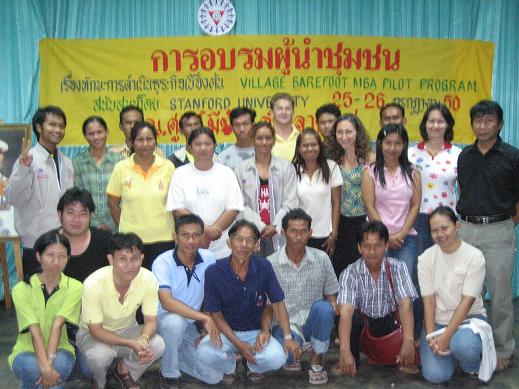
students, teachers and staff

LAMPLAIMAT, July 26 We’re amazed at how well the first day went. Having finished writing everything and testing it yesterday before class, we’re allowing ourselves a slow day that starts later than our usual 8 a.m. We spend our day finishing the agenda and timing the lesson plan, and we plan to meet this afternoon to discuss lessons from last night and the final plan for tonight.

We take to heart last night’s feedback that the lesson was too simple for some, too abstract for others and cross our fingers that tonight’s session, which incorporates two lessons and an even more interactive game, will cater to a broader range of backgrounds. We also update tonight’s game to reflect outcomes of its test, which indicated that we weren’t giving players enough supplies or sample baskets.

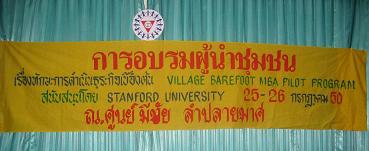
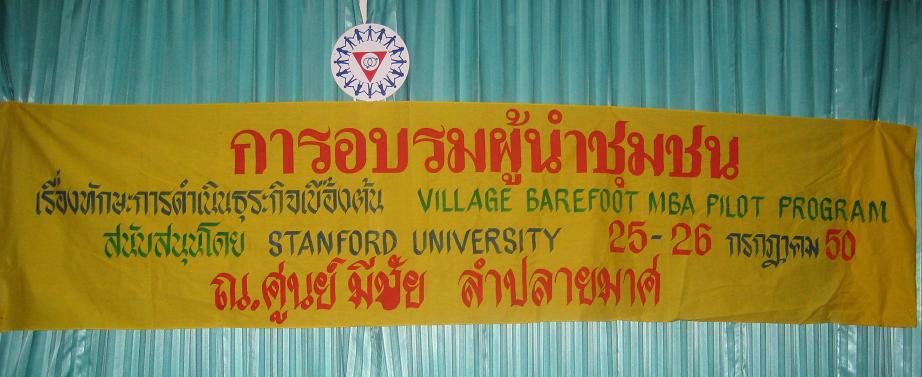
Shortly after the session begins, we’re surprised by a banner our hosts have created and, surreptitiously at first, hung in the room (see the new picture at the header of the page). It formally announces our project and serves as yet another tangible symbol of how our creation, merely thoughts just six months ago, has become something larger than the growing contents of our hard drives.

As the students arrive, they greet us with warm, appreciative smiles. They are more talkative and relaxed than they were yesterday. We also notice that Khun Sombat, whose diversified and very successful farm we visited last week and used to adapt several of our stories, is among our students. We’re honored that someone who is already a success, and from whom we stand to learn plenty, would take time to learn more, and from us.

As the last of the students finally enter, again at about 5:20, Khun Tom begins the session with another ice-breaker, this time a song in which participants fill in details of the chorus with different products that can be made with bamboo. We are even invited, through Anita’s translation, to come up with examples that had not yet been used. Despite the language barrier (we didn’t know the villagers’ previous examples) and cultural distance (using bamboo daily in Palo Alto isn’t exactly commonplace), we pass the villagers’ test (Scott’s example: bamboo forks, Katherine’s: bamboo scaffolding).
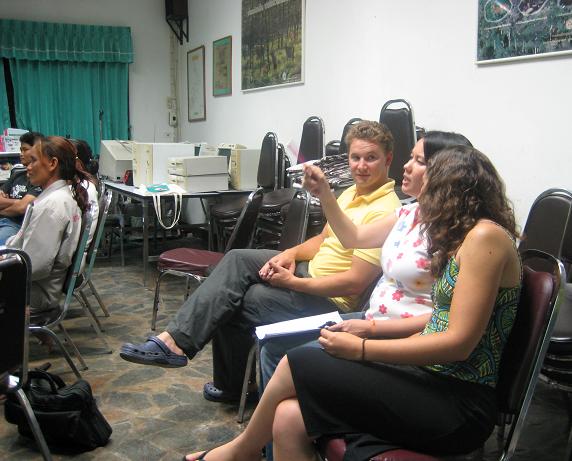
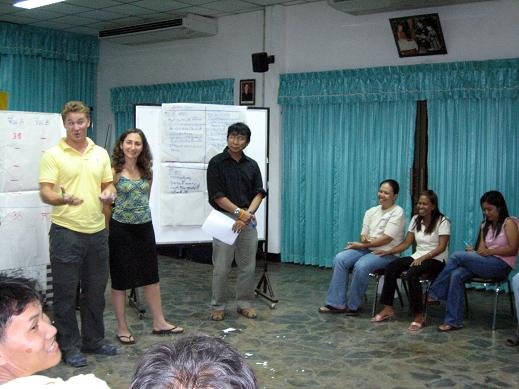
Anita translates for Katherine and Scott

Khun Prahat welcomes the group and begins the lessons and stories about marketing and production. The students again listen intently, knowing what format to expect and behaving in a way that suggests that, beyond polite respect, they find real value in the lessons we’ve written. As they discuss the lessons, what each participant did and how it improved business decisions and outcomes, they come up with a list of key points that look very familiar because they strikingly resemble the 4P and 3C frameworks we learned in our Core marketing course. (These frameworks are intended to help guide thinking about key factors in making decisions about any product. The 4Ps: Product, Price, Promotion, Placement in market. The 3C’s: Company, Competition, Customer.) Their shorter version contains Promotion, Product, Customer and Company – more than half of our list despite barely an hour, let alone two years, of business school.

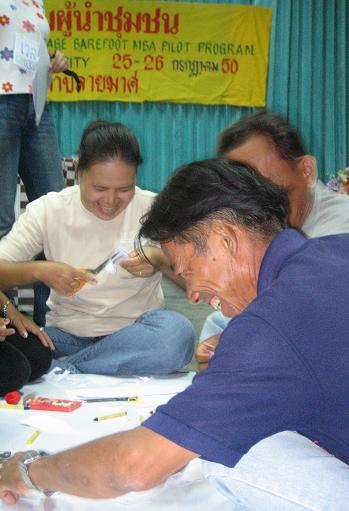
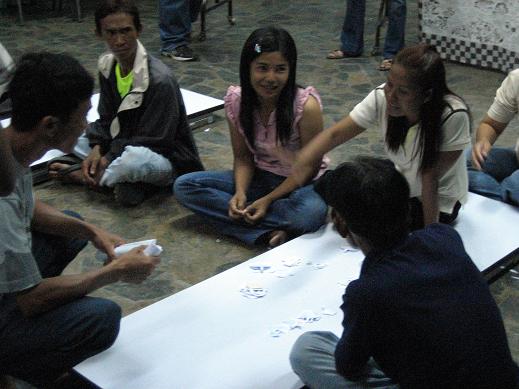
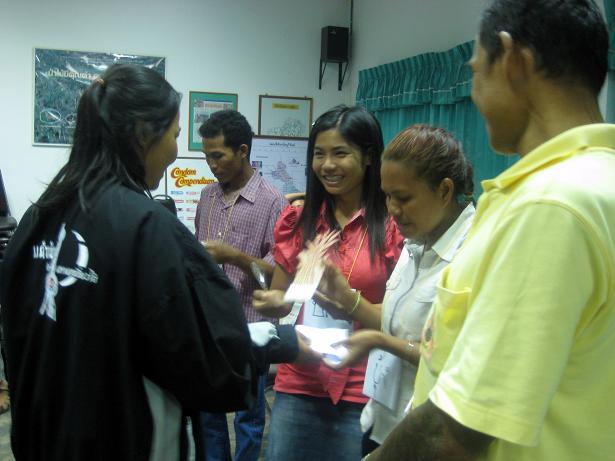
Khun Tom introduces the next simulation. This one involves making and selling a product, bamboo baskets from strips of paper cut to mimic bamboo rods. He enthusiastically divides the group into three teams: one group of five customers who each will assume preferences and a budget, and two teams of five who will interview the customers, decide what to make and make it – all in 15 minutes. The production teams then will try to sell each product to the customers, who may buy the product from whoever met their needs. If the product doesn’t meet a particular customer’s needs, he may refuse to buy anything.

We were careful to introduce the exercise as a way of further understanding the details of lessons about successful production and marketing, not a juvenile arts and crafts project. Just as we did when faced with a similar simulation and explanation during pre-term two years ago, our students jump into the task with great effort, a large dose of creativity and broad smiles. They emerge excited and energized, ready to talk, more than they have been to date, not only about the lesson but about what they’ve learned from it.

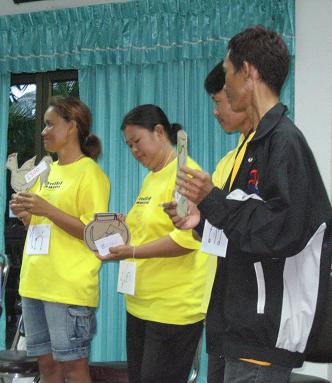
One team produces in bulk, creating some 50 baskets cut from the paper bamboo. The other team makes more three-dimensional baskets, and consequently fewer total baskets. Their production styles are different, suggesting they are targeting different customers.
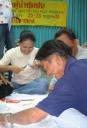
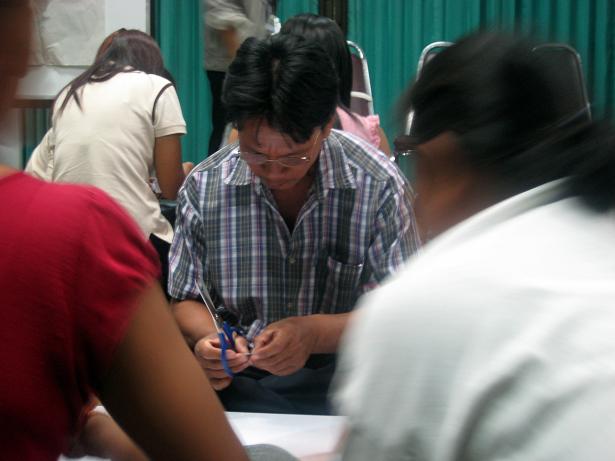
Production activity making baskets

When it comes time to sell, the lessons begin to emerge. Two customers’ basket specifications weren’t met, so only two buy baskets. One team sells raw bamboo rods, but only because it markets them better than the other team does. The teams quickly learn to differentiate themselves, not in their products’ prices, a quick way to eliminate any available profit, but in explaining how their products’ features meet their customers’ needs – exactly the combined lesson in production and marketing we had in mind.
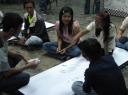
Selling baskets

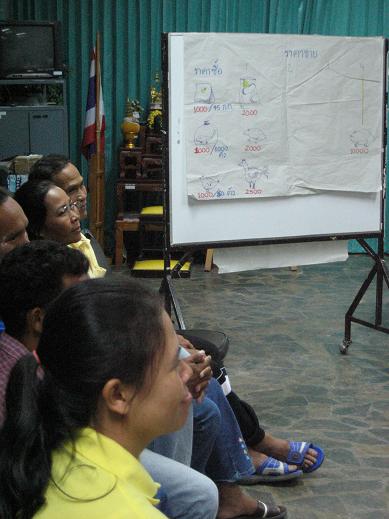
In animated Thai, the villagers discuss what worked and what didn’t – as producers, as marketers and as customers. After 10 minutes, their comments fill a two-by-two matrix that, with a few PowerPoint bells and whistles, could pass for one for which consulting firms have become notorious.
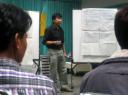
Takeaway matrix

Our students are beaming and excited for more. We are too.

We end the lesson with one last round of Q&A, but this time, the tables are turned – on us. They ask about the weather in California (cooler than here), the cost of a plane ticket to Thailand (more than the average annual wage here), what kind of farming we do at home (a houseplant or two?). They wonder why we smile so much. We are too elated to do anything else.
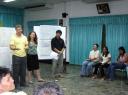
Q&A

We beam at the expressions of comprehension and gratitude written on the villagers’ faces and can’t help but reflect on how wonderful it is to watch what we’ve created morph from idea into reality. It’s taken a life of own. And they want more.

The first day was too easy, but they understand easy is where things start. They want the other 12 lessons – the ones we’ve put on hold for now. We have information to create them, but our time here is coming to an end.

We spend the holiday weekend reflecting (including writing this blog) and creating a final presentation and materials for PDA so they have at least these three lessons to integrate into their work. Now that we understand what it takes to adapt a lesson successfully to the environment here, our next major task, after we leave Thailand, is finding a way to complete the remaining 12 lessons. We will need to create lesson plans and make sure the new lessons work equally well. We plan to talk through details with Khun Mechai and the PDA staff at our final presentation and then search for resources to help us complete this project as we resume the other commitments in our lives.

First day of school

Barefoot MBA banner

LAMPLAIMAT, July 25 — Our students trickle in. They come from different villages, after work, after farming. They take motor-scooter taxi rides, ride their own scooters or get rides from friends or family members. As they arrive, Khun Tom keeps them entertained with jokes (not all of which elicit laughter) and discussions to get to know each other.

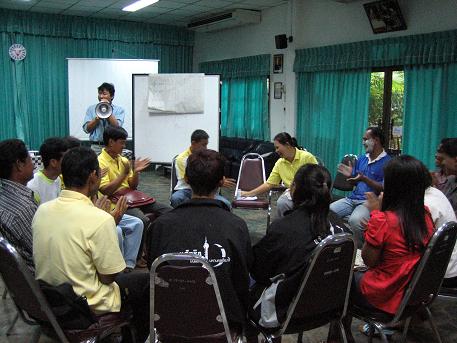
Icebreaker

When all 14 students arrive, we begin a few ice-breaker exercises intended to relax the group, acclimate them to a new environment and create a sense of membership among this otherwise separate group of individuals. They go through introductions, play a hot-potato-like game (instead of moving, a bottle of baby powder is passed around, and when it stops, that person applies a handful of baby powder to his own face or that of someone else). They smile and laugh as if they met long before they walked through the door minutes earlier. As they finish, Khun Prahat, the elder professor for the evening, introduces the evening, the lesson and us.

Scott and Katherine introduce the Barefoot MBA

We introduce ourselves and ask a few questions. How many are rice farmers (about 10 of the 14), how many have another business (6: working in a call center, electronics repair, growing fruit, growing vegetables, raising fish and frogs), how many are in debt (all, including, at the moment, the authors). With this common bond, we hope that the lessons will help the villagers grow their businesses, get out of debt and be more prosperous.

Khun Prahat introduces the lesson of the evening: investing.

Khun Prahat tells investing stories

As we follow along, partly through translation and partly through noting the timing, we’re struck by how the students are, well, acting like students. They take out pens and paper to take notes. They ask their neighbors clarifying questions. They ask questions of the professor. They answer questions from the professor. It’s a real classroom, and a real lesson – and only days ago it was just words on a computer screen and an empty multipurpose room.

Playing the investing game

After Khun Prahat tells and leads an initial discussion of the stories, Khun Tom again leads the students through an activity to make the investment lesson more real. He divides the students into groups (through a musical-chairs like activity) and assigns roles. In each of two rounds, four of the students play rice farmers with extra profit from their rice crop. Each has a choice of what to do with the same amount of extra profit: save it, grow more rice or invest in a number of different items, morning glory seeds to grow flowers, tadpoles to raise frogs, a baby pig to fatten into a sow or seeds to grow bean sprouts. Each investment has a different maturity length and thus can be sold at a different time and for a different price. Some players can choose to reinvest their additional profits or hold them.

Props

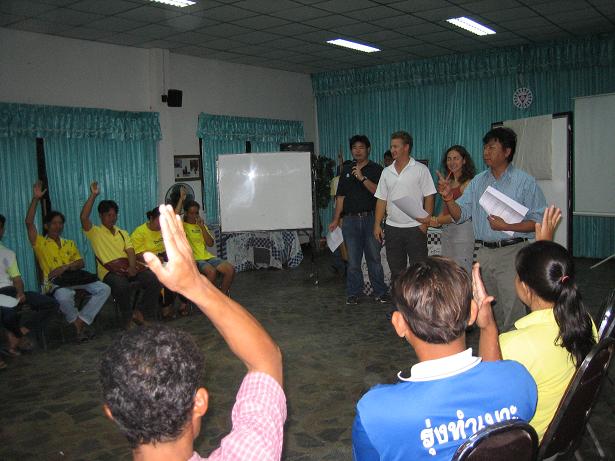
They engage in the game, seeing the different results and wanting to make other choices. At times they are prepared to make the game more sophisticated than we initially planned, like by having the morning glory investor invest in fish when morning glory season is past its prime. As they discuss the results, many are aware of the idea of investing as we’ve presented it but hadn’t thought of some of the examples. We discuss other options for investing extra profits, the pros and cons to different investments, the different seasons in which they are relevant and the pros and cons of long- versus short-term return.

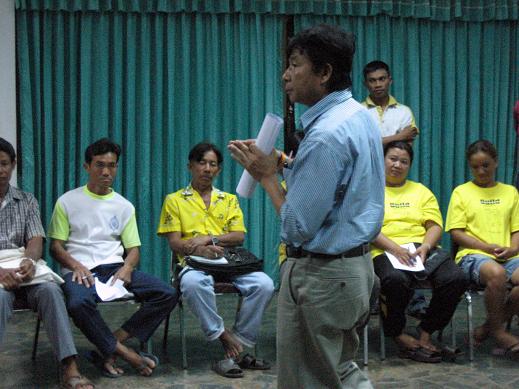
Students listening

We step back a number of times to marvel at what we’ve created and how it is now alive, indestructible. Knowledge and information, now released into the open, cannot easily be undone. Knowing this, we’ve been a bit nervous that this wouldn’t work, that the students would be bored, withdrawn, insulted at the simplicity or cultural mistakes or oversights we’ve made. At some level, we partly expected some unforeseen error to grind everything to a halt. Remarkably, it didn’t. Instead, the lesson flows smoothly, the students are interactive, smiling and participating, and the teachers do an incredible job of managing the classroom and guiding this group through the first day of the Barefoot MBA pilot. Locals who, two weeks ago, had not met us have taken our ideas and brought them to life.

As the day comes to a close, our biggest takeaway is that the lesson was a bit too simple. The villagers want more practical skills about things like marketing and production. They want an instruction book, not ideas. They, like many students, want the answer, not the lesson. We’ve tried to provide a simple lesson, and, through activities with usable examples, very applicable activities to better understand that lesson, but we have intentionally stopped just short of providing instructions. Instead, we hope students will come to those on their own, through guided discussion at the end of every day. We also hope that tomorrow’s lessons on marketing and production will be a bit more challenging and more appropriately meet their needs.

We quickly realize that the students’ praise and asking for more extends beyond the gracious Thai culture. As we enjoy dinner together after the lesson, many of the students come up to thank us, either in Thai or a simple but telling English “thank you.”

It’s perhaps the most genuine and meaningful thanks we’ve heard.

Final preparations

LAMPLAIMAT, July 24 – We have an early start this morning, beginning to go through the lessons in English and Thai, make any final adjustments and then, as our educational experts remind us, face the 60 percent of teaching that is process: how the lesson is taught.

Our local advisors believe that teaching by story-telling, while interesting, hopefully memorable and not too long, might still be boring. To make the process more interactive than a story and a discussion are, we’ve decided that a game might help. And, in the area of learning business through a large, group game, Stanford has once again provided us with useful experience. (The first time many of us met at Stanford was at a pre-term session where we were assigned various roles in a group, and different groups competed against each other to produce and sell greeting cards. The discussions that followed covered topics from ethics to teamwork, planning to leadership.) Drawing from that experience, we’re creating two games, one for investing on the first day, and another that will incorporate two lessons, production and marketing, on the second day. Our goal is to turn the stories and discussions, which are still somewhat more conceptual than our audience would like, and add an aspect that is more applied, more tangible.

As we slowly go through the games, we review the overall learning goals (making sure they are consistent with the players’ goals) the rules, the answers to potential questions, and where we will and will not exert control of aspects of the games.

Final preparations - Lamplaimat

Anita, our incredible translator (and CSR officer at PDA), manages to facilitate the day in two languages, keeping all parties involved and informed. Before we even finish the first game, the PDA staff comes up with an idea for a second game that incorporates the marketing and production lessons into a game of making and selling baskets made of paper strips representing bamboo. We’re delighted to see how well this is coming together: Our lessons now have lesson plans, an outlined agenda and formal teaching notes – and, perhaps most importantly, the support of everyone involved.

Scott creates game pieces

Tomorrow we’ll finish writing the basket-making game and test it with some of the staff here at the Lamplaimat center. Then, at 5 p.m., the show begins: our students arrive and, ready or not, the Barefoot MBA leaps from the page and becomes real.

LAMPLAIMAT, July 25 – Our test with the staff goes better than we imagine. Their creativity and skill with scissors and pens produces paper baskets more intricate and functional than we would have expected. (We assumed they would draw, color and cut out basket shapes; instead, they assembled three-dimensional bags with staplers, tape and paper, including exterior pockets, multiple color options and different handle lengths.) The feedback we receive is helpful.The questions the staff members ask are insightful for what our activity contains and what it does not.

We spend the afternoon making a few revisions. Soon, 5 p.m. arrives, and, slowly, so do our students.

Context

LAMPLAIMAT, July 23 – After a four-hour van ride, we make it to Lamplaimat to learn that a nearby village is having the first meeting of its Village Development Committee, the group PDA gathers to lead a village’s Village Development Bank. (This is more relevant to our host organization, PDA, and its going into rural villages to introduce and encourage villagers to create their own banking system, grow their local economy and pull themselves out of poverty – a far more empowered state than calmly waiting for the next round of NGO handouts and tolerating illness, poverty, lack of education and deteriorating village social conditions. This isn’t a forum to detail PDA’s work, or our high opinion of what it’s doing, other than as context to testing our curriculum. For background on our project, see the links in the sidebar to the left.) We hope the meeting will provide further insight into the mindset of villagers who come together to lead new initiatives in their village and begin the journey out of debt and away from subsistence living. We’ve come to meet them, to listen to their questions of process of the formation of a community-owned village bank and to better understand the individuals who will be receiving a Barefoot MBA, or at least the precursor to such a degree (no, it’s not really a degree, but a set of concepts we hope will help in their pursuit of a better life).

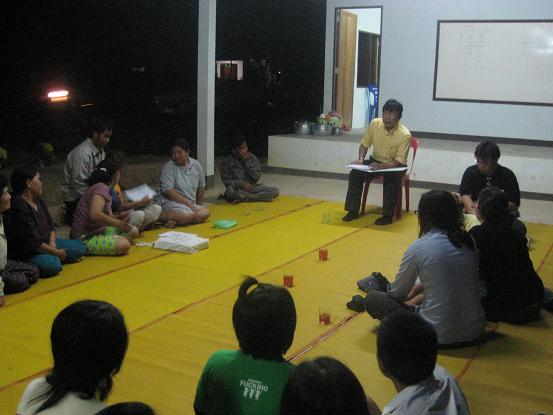
Village Development Committee meeting

Lightning flashes in the distance. We listen as the villagers review the purpose of the 24-member committee and then discuss the specific responsibilities of each sub-committee. We hear their confusion about bookkeeping (our classmates had similar questions in Accounting), we see the youth committee’s enthusiasm about running a garbage recycling business (similar to our classmates who passionately chased idea after idea, trying to turn each into a profitable startup) and we saw the pointing of fingers as nobody knew who had the documents outlining how they planned to allocate the funds they would receive from the Village Development Bank (we’ve all had one of those moments).

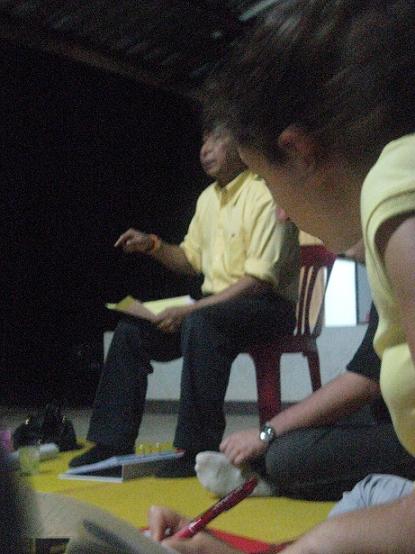
Khun Prahat talks, Katherine listens

As bugs continue to swarm around the fluorescent lights above and fall into our juice, we’re struck by the similarities of questions heard at Stanford and those asked here tonight. That’s not a comment on either group; rather, it’s a somewhat reassuring notion that, separated by so many factors, we’re truly not that different after all. Sadly, we’ll have to have that comment translated to share it with the villagers.

Just before we break for dinner, around 8 p.m., another representative of PDA changes the topic to something more serious. Recently, a young teenager accidentally became pregnant, the young father to-be denied responsibility and her family disowned her. She’s gone to Bangkok, and that’s the last anyone’s heard from her. The message here is that safe sex and condoms do more than prevent disease; they also keep families and communities from breaking apart. And, just as PDA provides the tools for the villagers to improve their financial lives, PDA also provides the tools for these villagers to improve their health. Amazingly, the staff members of PDA have built up enough trust with these villagers that few are turned off by talk of safe sex and condoms.

They learn here together at this small community center, a 20-by-30-foot slab of dusty concrete with a tin roof, one exterior wall and fluorescent lights that’s used for everything from community meetings to yoga classes. Elders and teenagers come here, ask questions, listen intently and walk away prepared to take action to move the village in a new direction.

We have partnered with PDA because of the trust they have developed with villagers here and everywhere they work. The community-education model is one PDA has shown to be effective here and one we trust will continue to work as new lessons are taught to villagers, whether about community organization, health practices or business education.

Synthesizing information

BANGKOK, July 19 – Back from Buri Ram province in the northeast, we now face the challenge of distilling the stories we’ve heard and businesses we’ve seen into a few key differentiating factors. Condensing two years of Stanford Graduate School of Business into 14 lessons was enough of a challenge over the past six months. (For background on our project, see the About and Executive Summary links in the sidebar to the left.) We now have to fit the lessons we want to teach into two Barefoot MBA teaching sessions next week, two hours on Wednesday night and two hours on Thursday night. From the curriculum we’ve already developed and the new information we’ve learned here, we must determine what is most important for these villagers to know.

What knowledge makes a successful business stand out? Empirical studies fail to provide an answer and instead leave plenty of room on entire bookstore walls dedicated to key business secrets – which, amusingly, seem to change about every six months. We don’t propose to have any more of an answer than the authors of so many ephemeral best-sellers. Instead, we have focused on the differences between what the few successful entrepreneurs here do and what everyone else does. It’s a bit like looking through time, when life was simpler and these questions had clearer answers. What business practices are essential to bridging the gap between success and everyone else (not necessarily failure, but subsistence living that keeps many villagers living in poverty and debt)? What information will help these villagers see the first small steps to growing their business, rather than the large gap between where they are and where they want to be? What is the common practice that could use revision?

We found answers in our discussions with entrepreneurs over the past weeks. The differences come in subtle but noticeable lessons. The successful people break from common practice. They take profits from rice farming, use some to replant rice for next year and then do something different. They use the remaining profit to plant a new crop, raise a pig – or fish, or frogs, or fruit trees. They test their own products and try to improve them. They talk to customers to determine what they want and make products accordingly. They join together with other producers of similar goods to collectively bargain for lower transportation costs to get their goods to market. And, most remarkably, they have a very precise knowledge of the financial status of their businesses, both in records and in their heads.

Knowing this, we have narrowed our curriculum of 14 topics to 3 or 4 we think we can pilot next week:– Investing (business growth)

– Production (value-add services available to existing market products and materials) – Planning & Records (tracking investment and business growth)– Marketing (understanding customers, explaining a product to them)

We’ve changed the business examples in each lesson to correspond to best practices we’ve seen this week and changed the figures to correspond to local market prices. Our curriculum will be translated this weekend, and next week we head back to Lamplaimat to work with the PDA employees who know these villagers and will teach the curriculum. Together we’ll go through the lessons and think of ways to bring them to life for our students, through role playing, discussion questions or even the dreaded business school cold-call.